
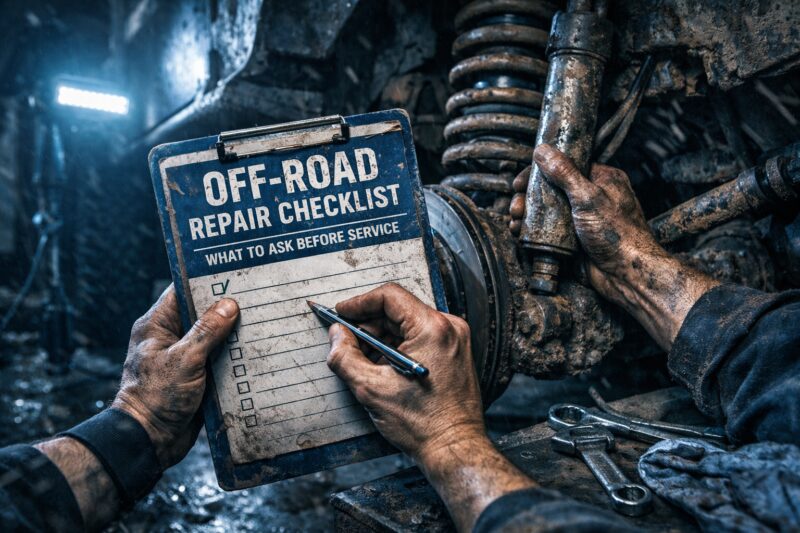
If you’re paying for Off-Road Repair, the smart question is not “How much for parts?”—it’s “What tests prove the root cause, what evidence justifies the work, and what will you do if discovery changes the scope?” Asking for diagnostic proof, an itemized estimate, and a written warranty-and-acceptance plan helps prevent misdiagnosis, upsells, and repeat visits.
This matters commercially because off-road vehicles often present intermittent symptoms (heat-related failures, mud/water contamination, or driveline stress) that can be misread as a one-part fix. A clear diagnosis timeline reduces your downtime, itemized scope reduces surprise costs, and explicit warranty terms clarify who pays if the same failure returns. The goal of this Off-Road Repair service checklist is simple: help you move from uncertainty to documentation, so you can approve the right work with confidence.
Use the checklist below to compare providers. Each section tells you what to ask, what evidence to request, and what decision criteria to use before you authorize any teardown, parts ordering, or “discovery” work.
Off-Road Repair intake: what to ask to confirm the problem (not just the parts)
The first thing to ask before paying for Off-Road Repair is how the shop will confirm the problem using a diagnostic process—not how fast they can quote parts. You want symptoms translated into systems, then into tests, then into decisions with evidence.
Commercially, this protects your budget and time-to-repair because off-road failures often start as one underlying condition and then cascade. For example, a bent control arm can shift alignment and overload a tire, creating vibration that seems “like a tire issue” until the shop measures geometry. When a provider jumps straight to the most expensive component without testing, you may pay twice: once for the wrong parts and again for the true repair.
Practical intake should follow a structured chain: symptoms → likely systems → specific tests performed → pass/fail criteria. Ask for a “what failed first?” explanation, because “what’s broken now?” is often only the end result. This is also where you can set boundaries: request that the technician document what they inspected, what they ruled out, and why.
The most effective shops also provide an Ask about diagnosis timeline and explain whether they do same-day triage or require teardown. Tradeoffs exist: a fast estimate can be appropriate for bolt-on items, but drivetrain, steering geometry, electrical, and brake hydraulic work typically need controlled inspection to avoid repeating the same issue. A good real-world example is suspension noise after a trail impact: the shop may triage quickly for obvious damage but still plan a controlled inspection of mounts, bushings, bearings, and alignment before finalizing scope.

Finally, go beyond the visible. Off-road use can hide damage that doesn’t show up at a glance: heat-damaged boots, misaligned shafts, bent skid-mount brackets, compromised welds, or contamination embedded in fluid lines. Ask for documentation of “hidden damage inspection examples” such as measurements, photographs, and test outputs, so you can verify that the recommended work addresses the root cause—not just the symptom.
Scope & estimates: questions that protect your budget and prevent rework
Before authorizing work, ask the provider to define the scope precisely and explain how the estimate changes if discovery reveals additional damage. In Off-Road Repair, “we’ll see when we open it” can become a cost trap unless you put approval gates in writing.
Start with how they break down labor, parts, fluids, consumables (like seals, crush washers, shop supplies), and any diagnostic-only charges. Confirm whether your estimate is diagnostic-only, repair-only, or repair + verification, because the pricing structure changes depending on whether they will re-test and measure after parts are installed. If the quote is broad, require explicit acceptance criteria for “completion,” such as alignment range goals, leak-free confirmation, brake pedal feel targets, or vibration reduction with documented observations.
Then request a clear work order: parts list (including part numbers or alternates), labor tasks in plain language, any torque specifications or standards followed, and the final inspection steps they will perform. For example, a correct driveline repair isn’t just “replace U-joints”; it includes checks for yoke condition, slip-spline condition (where applicable), fastener condition, and a post-install verification plan.
Warranty and workmanship standards should also be explicit. Ask about labor warranty length, which parts warranty source applies (OEM, remanufacturer, or shop-supplied), and what exclusions exist for off-road abuse (such as impact damage or misuse). Deeper than obvious: ask how they handle parts availability and lead times when OEM vs. aftermarket differs in fit, coverage, or spec. If lead times are long, ask what they will do in the meantime (temporary fix eligibility, storage fees, or an alternate sourcing plan with documented compatibility).
Tradeoff to understand: tighter scoping may require additional diagnostic time upfront. However, a better scope protects you from rework because it ties the “why” to the “what,” so the second teardown is less likely. If a provider can’t define discovery rules, you should treat it as a red flag in commercial decision-making.
Parts and workmanship standards: what “quality” means for off-road vehicles
Ask the shop what “quality” means in measurable terms for your specific off-road vehicle and use case—then request that they install to standards, not to shortcuts. Good Off-Road Repair quality is proven by correct specs, cleanliness, and verification after assembly.
Start with parts categories and rationale: OEM, OEM-equivalent, or aftermarket, and why each choice matches your terrain, load profile, and expected durability needs. A parts “brand” alone doesn’t guarantee quality; what matters is whether the part meets material and tolerance requirements and whether the shop can document that they installed it correctly. Practical application: if you run larger tires or wheel spacers as part of your build, request that the shop confirms compatibility and re-checks alignment and geometry after replacement.
Next, ask for installation standards you can verify. Examples include alignment checks, bearing preload rules, sealant/cure procedures (and which products they use), and correct fluid types and grades. For axle and differential work, ask whether they follow the service manual’s procedures for cleaning mating surfaces, using new seals/fasteners where required, and performing correct refill and leak checks. For braking work, ask about contamination handling and verification steps that confirm hydraulic integrity and pedal consistency.
The deeper insight is that workmanship failures are frequently preventable but easy to miss: improper sealing, reused fasteners, contaminated fluid lines, misrouted wiring after mud exposure, or seals installed without correct seating. Ask how they prevent common off-road failures such as moisture intrusion into electrical connectors, heat damage around boots, and contaminated grease paths in steering and suspension components.
Tradeoffs exist. OEM parts can cost more and have longer lead times, while aftermarket can be durable if it is engineered correctly and installed to the right specs. A reputable provider will discuss these tradeoffs with you and tie the recommendation to your off-road profile rather than treating every vehicle as identical.
Choosing the right service route: shop repair, mobile service, or DIY support (tradeoffs)
Ask which service route they recommend for your specific repair and why—shop, mobile, or DIY support—because the right route depends on safety-critical complexity and required tools. “Mobile” can work for simple diagnostics or minor bolt-on repairs, but many driveline, suspension, brake, and electrical repairs require controlled environments.
Commercially, the service route affects turnaround time, evidence you receive, and your risk exposure. A shop with a lift, alignment equipment, scan tools, and spec-driven procedures can validate outcomes more reliably than a “quick fix” approach. Mobile service can reduce tow and downtime, but it may limit measurement precision, parts inventory, and documentation quality. If you want fewer repeat visits, choose a route that matches the verification requirements of the repair.
Define when mobile/off-site help is appropriate: light diagnostic work, confirming a loose connection, basic fluid checks, or replacing accessible components. Ask where teardown is mandatory—particularly for safety-critical systems like brakes, steering linkages, and driveline components where partial repair can be unsafe or might not meet warranty acceptance. If you’re considering DIY/assisted repair, ask what the shop will and will not warranty when parts were installed elsewhere, and whether they will provide inspection or torque verification as a standalone service.
Also ask about data access: can they share inspection findings, scan results, measurements, and test outputs you can keep for your records? That willingness is a practical marker of transparency. The deeper issue is liability and feasibility edge cases: a provider may agree to help with parts you supply but still refuse to sign off on alignment or torque verification if they can’t perform the necessary checks.
Finally, request that the provider outline how they will communicate discoveries and approvals regardless of route. If you select a shop for repair, ensure they include a post-repair verification plan. If you select mobile diagnostics, ensure they specify the pass/fail criteria that trigger a full shop teardown.
Advanced checklist: edge cases and “what most guides miss” in Off-Road Repair
The advanced Off-Road Repair questions are the ones that protect you from cascade failures: how the shop connects cause-to-symptom across suspension, driveline, alignment, and contamination. If they can’t explain the failure chain and verification steps, you may get a fix that fails again soon.
Start with driveline and suspension knock-on effects. Ask how the repair addresses the cause, not just the endpoint—how mounts, shafts, joints, and alignment are checked as a system. For example, after a trail impact, a bent component may be the visible part, but the underlying issue might be a misalignment that accelerates bearing wear or stresses U-joint geometry. A quality provider should show how the repair plan prevents that chain reaction from repeating.
Require verification steps after work. Ask for a road-test protocol that’s more than “it drives fine.” Examples include what they will observe (vibration frequency and speed ranges, steering pull behavior, brake fade indicators), how long the verification run will be, and when they will re-check torque where appropriate. Ask for post-repair measurements—alignment targets, runout checks where relevant, and leak verification steps.

Cover corrosion, mud/water contamination, and electrical gremlins. Off-road vehicles can develop intermittent shorts or sensor drift after water intrusion; the “fixed” symptom might only appear stable until the next heat cycle. Ask what testing they do before declaring the issue resolved, such as connector inspection, moisture intrusion checks, insulation resistance testing when appropriate, and scan tool verification under real operating conditions.
For recurring issues, prompt them directly: “What would make this likely to return?” and “How do you prevent repeat failure?” This forces root-cause thinking. Most guides miss the risk tradeoffs of durability decisions after off-road use: warranty limitations tied to abuse, choosing upgrades that improve sealing or impact resilience, and how they balance performance vs. safety operating limits.
As an internal planning point for your decision process, you can align your documentation requests with broader “Warranty and workmanship standards” expectations so each provider’s claims are comparable.
Common mistakes and misconceptions before paying for Off-Road Repair
Avoid paying for Off-Road Repair based on symptoms alone; the biggest mistake is confusing “part replacement” with “root-cause repair.” If the shop cannot show diagnostic proof and acceptance criteria, you are funding uncertainty.
One common misconception is that replacing the obvious broken component automatically fixes the failure mechanism. In off-road contexts, the real cause is often upstream: misalignment, contamination, impact damage, wrong fluid grade, or incorrect torque leading to repeat loosening. Ask how they prove the failure mechanism, not just how they justify the part choice. Practical application: if you’re told to replace a bearing because it’s noisy, ask what they measured (play, contamination signs, seating condition, alignment) that confirms cause rather than treating the noise as the cause.
Second, avoid vague quotes. Require itemized estimates and defined acceptance criteria for “completion.” If you don’t define what “done” means, disputes become likely after the parts are installed. A quality provider should outline final inspection steps and what documentation you will receive.
Third, don’t accept “we’ll see when we open it” without a discovery policy. Ask how costs and approvals are handled: what triggers extra work, what threshold requires your sign-off, and whether they will provide photos or evidence before proceeding. This is where commercial risk management matters—discovery should be structured, not open-ended.
Fourth, don’t misinterpret warranty terms for off-road usage. Ask specifically what coverage remains and what voids it. A “warranty voided” outcome can be especially damaging if the shop’s installation quality is the actual factor. Finally, watch for diagnostic bias: shops that start with the most expensive component first can create a false certainty narrative. Request evidence for each major recommendation so you can avoid paying for expensive guesses.
If you want to compare providers efficiently, use an Off-Road Repair service checklist approach: consistent questions, consistent documentation expectations, and consistent approval thresholds across shops.
Alternatives and upgrade paths: what to ask when repair isn’t the best answer
Before you approve Off-Road Repair, ask whether repair, rebuild, or replacement is the best answer based on wear data—not just parts pricing. Sometimes the most commercial-efficient decision is a rebuild or a durability-focused replacement when evidence shows the component is beyond safe service limits.
Start by requesting the decision basis: ask whether they recommend repair, rebuild, or replacement based on wear-data and measurement, such as bearing condition, tolerance wear, rotor/drum condition, shaft straightness, or housing integrity. A good provider should show how they reached the conclusion. If a shop can’t justify the recommendation with measurements or inspection results, you should request additional documentation before approving costly work.
Next, ask for durability-focused alternatives appropriate to your off-road profile. If you frequently run mud, water crossings, or heavy loads, ask what upgrade options improve sealing, impact resilience, heat management, or contamination resistance. Tradeoff to understand: upgrades can raise upfront cost, but they can reduce repeat failures and labor rework. That’s a commercial advantage because your downtime and future repair probability drop when durability is built into the solution.
Compare short-term repair vs. long-term value by asking for total cost of ownership reasoning: expected service intervals, likely failure likelihood under your use, and which choice is safer for continued operation. Discuss availability and spec matching: whether used, remanufactured, or aftermarket components meet the required tolerances and whether they come with a warranty that still makes sense for off-road use.
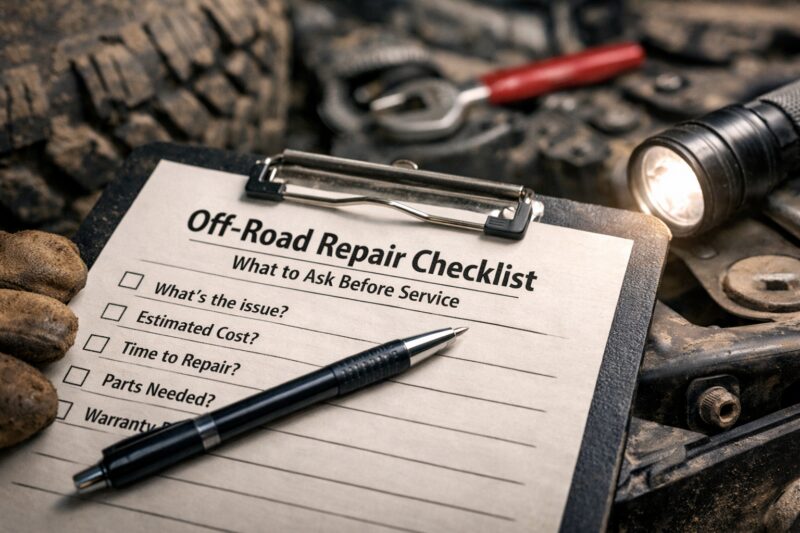
Finally, address performance vs. safety tradeoffs. Some upgrades improve durability but can affect handling, compatibility, or safe operating limits if the system isn’t re-validated. A quality provider should recommend changes in a way that keeps the vehicle within safe parameters after repair, rather than treating upgrades as purely cosmetic or purely performance-based.
Commercial credibility: what to request to evaluate an Off-Road Repair provider
To evaluate an Off-Road Repair provider commercially, ask for proof of capability, clear communication standards, and transparent parts-and-material choices. Credibility isn’t a promise—it’s documentation, repeatable processes, and predictable approvals.
Start with proof of capability. Ask whether they have the tools and documented procedures for your specific system and whether technicians have experience with similar off-road builds. For example, suspension geometry and driveline alignment require the right equipment and measurement discipline. Ask what internal processes they use to confirm correct installation—especially for torque specs, seal seating, and post-repair verification.
Second, confirm communication standards. You want a predictable workflow: how they report progress, how they request approvals, and how they document findings. Ask whether they will provide photos, measurements, and scan results so your “what happened” story is consistent across diagnosis and repair. This supports reduced repeat visits because you have a record of what was checked and what was corrected.
Third, require transparency on brand/material choices. Ask why a part is selected and how that choice affects warranty and durability under off-road conditions. Fourth, discuss scheduling reliability. Ask for expected turnaround time, priority handling, and what happens if parts lead times exceed the schedule. Deeper than obvious: request the quality assurance loop—what they do when test results conflict, how they handle customer disputes, and how they correct errors without making you pay again.
If you want an easy way to standardize your evaluation, treat each provider like a comparison set. Keep your questions aligned and require evidence for each major recommendation. This approach pairs well with a provider’s broader process philosophy described on pages like “Warranty and workmanship standards” to compare outcomes on a like-for-like basis.
Regional buying considerations (U.S.): questions tailored to how off-road service is typically handled
If you’re shopping for Off-Road Repair in the U.S., ask how their process adapts to your local environmental risks and parts logistics. Weather, road grime, and typical trail conditions can change both failure rates and what “good” looks like during diagnosis and repair.
In many regions, heat cycles and corrosion accelerate failures in clamps, connectors, and sealing surfaces; in other areas, mud and water intrusion are the dominant drivers of electrical and driveline symptoms. Ask what parts commonly fail locally and what preconditioning steps they recommend before declaring a repair complete. Practical application: a shop in a salt-heavy winter region should be able to describe corrosion control steps and how they prevent re-contamination when cleaning and reassembling components.
Next, ask how they source parts and manage shipping delays—especially for specialized off-road components, long-lead OEM items, or rare drivetrain parts. If they use aftermarket alternatives, ask how they ensure compatibility with your build and how that affects warranty. Commercially, you want predictability: ask whether they provide an alternate plan when lead times exceed expectations and whether they re-quote if parts availability changes your scope.
Also ask whether they can support state inspection requirements if relevant to your registration needs, but do it without derailment of the repair scope. For example, ask what they can do in parallel—documentation needed, inspection readiness checks, or how they handle emissions-related constraints if your region has specific requirements. Deeper insight: ask about documentation style and whether they can provide records that help you if you later pursue coverage claims or verify work history.
Finally, ask what they do to ensure long-term outcomes in harsh conditions: protective coatings where appropriate, connector sealing practices, and contamination prevention procedures. If you’re comparing providers, these region-specific questions help you choose the shop that understands the real failure patterns you face.
Frequently Asked Questions About Off-Road Repair
What should I ask before approving Off-Road Repair work?
Ask for diagnostic proof tied to specific tests and measurements, not a parts-based guess. Require an itemized estimate that separates labor, parts, fluids, and discovery charges, plus written approval thresholds for any additional work. Finally, request a written warranty summary (labor and parts) and clear acceptance criteria for what “completion” means.
How do I know if my off-road vehicle needs a rebuild or replacement?
Ask how they justify the recommendation using wear data and inspection findings, such as measurements, housing condition checks, and verification steps after disassembly. A rebuild decision should be tied to which components are within spec and which are not. If they can’t provide evidence, ask for the minimum documentation needed before you approve the higher-cost option.
Can a shop give a reliable estimate without tearing down the vehicle?
They can sometimes estimate reliably for limited, visible failures, but many off-road issues require inspection to confirm hidden damage. Ask what diagnostic scope they can perform first and what evidence supports the initial estimate. Also require a discovery policy that explains how the price changes and how you approve any added work.
What questions should I ask about parts quality and warranty coverage?
Ask whether they use OEM, OEM-equivalent, or aftermarket parts and what the selection is based on for your off-road usage. Request installation standards and verification steps, plus the warranty length and warranty source for parts. Be specific about exclusions that can apply to off-road abuse or impact damage so you understand what remains covered after repair.
How long does Off-Road Repair usually take and what affects turnaround time?
Turnaround time depends on diagnostic complexity, parts availability, and how much teardown is required to confirm root cause. Ask for an expected diagnosis timeline and what they do if parts arrive late or if additional damage is found. Also ask how they communicate delays so you can manage vehicle downtime commercially.
Do I need a post-repair inspection or test drive, and what should it include?
Yes—ask for a post-repair verification plan that includes specific checks, measurements, and a road-test protocol. For many driveline and suspension repairs, the shop should document outcomes against defined targets (such as vibration reduction, leak-free operation, and proper steering behavior). Request the re-check plan where appropriate, including torque verification and any alignment or runout measurements.
What are common causes of repeat failures after off-road repairs?
Repeat failures usually come from symptom replacement without root-cause confirmation, contamination left in the system, or hidden damage that wasn’t screened during inspection. Another common cause is inadequate verification after assembly, such as skipping alignment checks or not confirming torque and sealing integrity. Ask how they prevent the same failure mechanism from returning and how they document prevention steps.
How should I handle “discovery” findings that change the scope and cost?
Ask for written change orders with clear approval thresholds before any additional work begins. Request photos, measurements, or test outputs that explain why the change is necessary and how it connects to the original failure mechanism. If they can’t document discovery evidence, require they pause and reassess before spending your money.
What long-tail questions should I ask for driveline or suspension Off-Road Repair?
Ask how they verify cause-to-symptom connections across mounts, shafts, joints, and alignment. Require specific checks such as geometry confirmation, torque and fastener verification where appropriate, and verification steps after installation. For safety-critical repairs, ask what acceptance criteria they use to confirm safe operation and durability under off-road conditions.
Can I request photos and measurements during Off-Road Repair?
Yes—ask for photos of key damage points, plus measurements and test outputs that justify recommendations. Many shops can document scan results, alignment targets, runout measurements (where relevant), and leak test outcomes. Be clear about what you need for accountability before they start, since documentation quality is often easiest to standardize at intake.
Conclusion (planning notes for the writer)
To get the commercial value you’re paying for, treat Off-Road Repair like an evidence-based decision: insist on root-cause proof, demand itemized scope plus discovery rules, and verify quality through standards and documentation. If a provider can’t show how they confirmed the failure mechanism and how they will verify the fix, you’re taking on hidden risk.
These themes reduce repeat visits and protect your total cost by eliminating “guesswork labor.” They also speed decisions because you can compare two or three providers using the same acceptance criteria and the same documentation package. In 2026 off-road ownership realities, downtime is costly—clear diagnosis timelines and clear warranties help you plan, approve, and move on.
Next step: ask each provider for a bundle containing an itemized estimate, a warranty summary, and a verification plan (including diagnostic evidence and post-repair test expectations). If you want to standardize your evaluation, use this Off-Road Repair service checklist approach and require documentation at intake, during discovery, and after repair. For cross-checking capabilities and service expectations, you can also request references to relevant process pages like https://ntroffroad.edesignerz.com/services/ and supporting standards pages such as https://ntroffroad.edesignerz.com/about/.
Optional supplier comparison table idea: consider asking providers to fill a simple “diagnostic proof, scope itemization, discovery policy, warranty details, verification steps” matrix so you can choose the shop that is most transparent and most likely to deliver durable results.
Updated May 2026