
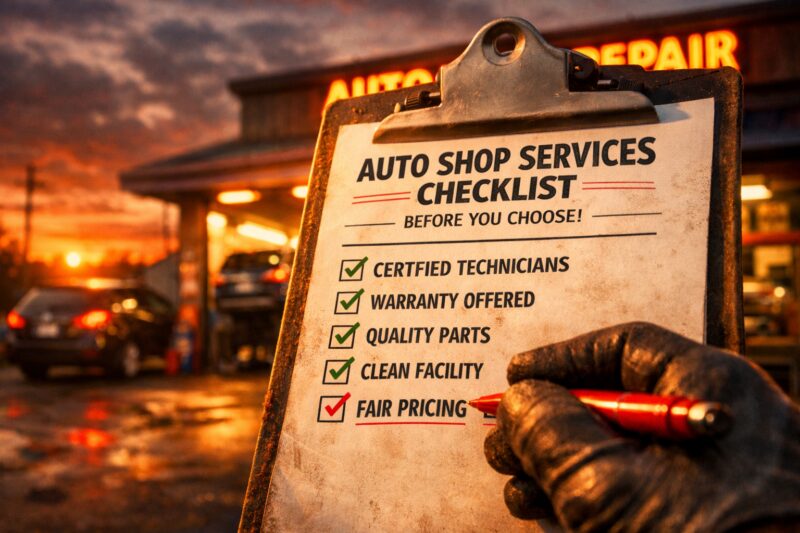
If you want to avoid wasted spend and surprise repairs, the checklist is a decision framework that forces every shop to document scope, diagnose method, and price the work clearly before you authorize anything. When you evaluate Auto Shop Services like a buying process—rather than “trust and hope”—you reduce risk, compare options consistently, and set expectations for what happens if the cause changes mid-repair.
In 2026, modern vehicles are increasingly software-driven: sensors, modules, and calibration routines can change the timeline and requirements for even “standard” jobs. That’s why your pre-decision should cover the whole chain—diagnostic-to-repair handoff, itemized estimates, authorization rules, documentation, and warranty terms—so you’re not paying twice for the same guesswork.
Use this article as a pre-authorization playbook. Print it, ask the same questions to 2–3 shops, and choose the one that can show its work in writing, not just promise results. If you’re shopping for Auto Shop Services in a hurry, this checklist keeps you disciplined enough to be fair to yourself and to the shop.
The Auto Shop Services Checklist: Your Pre-Decision Scorecard
A checklist helps you compare shops consistently by turning vague promises into measurable criteria you can verify before you pay. Instead of choosing the closest shop or the lowest quote, you score each option on transparency, diagnostic rigor, and accountability—then you authorize work only when confidence crosses a clear threshold.
Think of the checklist as a “pre-purchase scorecard” for repair work. A repair job has multiple stages—inspection, diagnosis, parts selection, labor, calibration, verification, and warranty follow-through. If a shop can’t explain how it moves through those stages, you’re not buying certainty; you’re buying a process that may consume your time and money while producing limited documentation.
To use the checklist effectively, keep your comparisons apples-to-apples. Ask each shop for the same core items: a written estimate (with line items), an explanation of the diagnostic plan, and a clear “what triggers cost or scope changes” policy. Good proof should look like itemized parts and labor hours, diagnostic findings recorded with measurements or scan data, and warranty terms in writing—not a hand-wavy verbal summary.
Here’s the deeper structure: organize your checklist into five categories aligned with commercial shopping intent. Transparency (written scope and pricing), capability (tools and fit for your vehicle system), process (how diagnosis becomes repair), cost control (what makes costs change), and accountability (documentation, warranty, and how rechecks are handled). What most guides miss is the “diagnostic-to-repair handoff,” meaning you should require a clear explanation of what happens when initial findings evolve.
Edge cases are where this scorecard earns its keep. If a fault is intermittent, if multiple systems could be involved (for example, an electrical concern that affects drivability), or if the vehicle requires ADAS calibration after repairs, a shop must state how it will verify the result before release. Your decision threshold should be explicit: authorizing work is reasonable when the shop has documented the suspected cause, the parts and labor scope, and the verification steps it will complete before closing the repair order.
As you gather questions, you can also review related guidance in a dedicated resource like off-road repairs checklist questions to see how specialized work should be documented and scoped before authorization. For general background on how a shop demonstrates credibility, use the shop experience and credentials criteria as a consistency check when you contact multiple providers.

Verify Competence and Fit for Your Vehicle’s Needs
The fastest way to waste money on Auto Shop Services is to choose a shop that cannot prove it can handle your specific vehicle system and failure mode. Competence and fit are about relevant experience, correct tooling, and documented procedures—not just general “we work on all makes.”
Start with how the shop handles “scope-fit.” Maintenance services, electrical diagnostics, collision-related repairs, transmission/drivetrain work, and advanced calibration tasks are not interchangeable. A shop may be excellent at brake jobs but lack the equipment or workflow for complex EV/Hybrid battery management faults or ADAS calibration requirements. When you ask what they will do first and what evidence they will record, a competent shop can translate that into a diagnostic plan without overpromising.
Use shop experience and credentials as your screening lens, but demand proof in the context of your job. Signals include technician training that matches your vehicle’s technology, documented diagnostic procedures, and the equipment required for the job type. For example, accurate drivability and emission fault resolution often depends on live data streaming scan tools and measurement discipline, while alignment-sensitive repairs require current alignment systems and verification steps.
Deeper-than-obvious: modern vehicles can include hidden requirements after mechanical work. Hybrid and EV vehicles may require specific procedures to manage high-voltage components and to validate faults after component replacement. For ADAS-equipped vehicles, calibration or reprogramming may be required after windshield replacement, suspension work, steering component changes, or certain brake/drive-system repairs. Ask what triggers calibration in your exact scenario and what documentation the shop will provide afterward (scan output, calibration report, and test/verification steps).
Common mistake: assuming experience with “your make” means the shop can handle your issue. A shop might sell itself as Toyota/Honda capable while lacking the diagnostic workflow for a specific system or module. Another failure mode is taking shortcuts on altered vehicles—lift kits, aftermarket ECU tuning, non-OE wiring modifications, specialty tires, or customer-supplied parts. In these cases, demand evidence: how they’ll confirm compatibility, how they’ll interpret nonstandard sensor behavior, and what documentation they’ll produce to show the vehicle is safe after work.
Pricing Transparency in Auto Shop Services: How to Compare Estimates Fairly
Fair comparison starts with estimate clarity, not just a number. In Auto Shop Services, the estimate is only useful if it breaks down labor hours, parts costs, and the diagnostic fees (and explains what could change).
To compare apples-to-apples, request the estimate in a written format that includes: the line-item description, the labor time (hours) for each task, the parts listing (with part numbers or at least equivalent specifications), and the diagnostic fee policy. If you’re comparing shops, ask whether the diagnostic fee is credited toward repairs or is charged regardless of outcome. Some shops provide verbal estimates for “authorization convenience,” but you protect yourself by insisting on a written version before work begins.
Evaluate labor rates and typical timeframes without chasing the cheapest price. A low estimate can be a trap if it assumes “typical symptoms” that may not match your specific fault, if it excludes key steps like cleaning, calibration, alignment verification, or reassembly inspection. Instead, assess whether the hours align with the diagnostic plan and the repair workflow. A shop that provides a well-defined plan can often give more accurate labor ranges and explain why certain tasks are included.
Estimate accuracy traps often include scope creep and “inspection” fees that don’t equal diagnosis. Clarify what the shop considers diagnosis versus inspection. Ask what will trigger additional authorization: for example, “If scan data suggests additional components, will you stop and ask first?” and “If disassembly reveals hidden damage, what is your process for documenting findings and requesting approval?”
Negotiation boundaries matter too. You can request alternatives such as OEM versus aftermarket parts or used versus new components, but you should not allow negotiation to remove critical safety steps. For example, if alignment verification, ADAS calibration, or labor warranty coverage depends on specific procedures, replacing those with cheaper shortcuts is a risk. If the shop offers options, it should explain tradeoffs in performance and coverage before you authorize.
When you call, you can also ask whether they offer a not-to-exceed authorization amount for parts and labor. If they do, confirm that it applies to the scope you’re authorizing. This reduces the chance you’ll get a surprise invoice due to an undefined diagnostic handoff.
Ask the Right Questions About Diagnostics, Authorization, and Documentation
The right questions ensure Auto Shop Services follow a predictable chain: symptoms lead to a diagnostic plan, a plan leads to written authorization, and authorization leads to a repair plan with verification. If any stage is skipped or undocumented, you’re more vulnerable to misdiagnosis and refund delays.
Use a step-by-step process when you talk with the shop. First, document symptoms exactly as you experienced them (when it happens, conditions, warning lights, any recent events such as battery replacement or curb impact). Second, ask what diagnostic steps they’ll take before proposing repair—initial checks, scan tool results, tests, measurement methods, and a summary of findings. Third, request a written authorization that specifies what work you are approving and what work requires additional approval.
Authorization rules should be explicit, especially for second-round diagnostics. If the shop finds “additional related issues,” ask whether it will pause, explain the new evidence, and obtain your approval before proceeding. The best shops use photo evidence and clear notes to show what they found and why the repair recommendation follows. Common customer mistake is assuming it’s okay to authorize work “on the fly” to save time; that behavior can reduce accountability and make warranty disputes harder.
Deeper-than-obvious: handle “silent failure” documentation. Some faults can be difficult to reproduce—an intermittent misfire, a connector that only fails when hot, or a vibration that disappears after a test drive. Ask how they record inconclusive diagnostics and what happens if they cannot reproduce the fault. You want a plan like: they’ll record scan snapshots and freeze-frame data, capture measurements, test drive under specified conditions, and return to you with either a confirmable cause or a “no-fault-found” report that explains next steps.
At completion, require key documents: a repair order that matches the authorized scope, warranty terms, the list of replaced parts, and archived scan data when relevant. If ADAS calibration or software programming was performed, ask for the calibration report and the software version or reprogramming documentation. This is where your checklist becomes actionable—you can verify the work performed matches the original authorization and that the vehicle was verified before release.
To sharpen your script, you can use a “question list” approach such as the guidance in off-road repairs checklist questions—the format translates well to any diagnostic-heavy job, including complex electronics.
Warranty, Parts Quality, and Guarantees That Protect You
Warranty protections are part of Auto Shop Services, not an afterthought. A shop should be able to explain parts quality sourcing, the difference between parts warranty and labor warranty, and what exceptions apply before you approve repairs.
Start by confirming parts quality expectations. Ask whether they use OEM parts, aftermarket parts, or remanufactured components, and how they handle tradeoffs such as fitment, longevity, warranty eligibility, and performance. If they recommend a particular parts grade, they should tie the recommendation to your vehicle’s needs and the risk profile of the component. For example, braking components and critical driveline parts require careful fitment; a discount part that doesn’t match specifications can lead to repeat service.
Next, understand warranty types. Parts warranty typically covers defects in the component; labor warranty typically covers workmanship if the installation is the cause of failure. Exclusions can include improper installation (by someone else), collision damage, improper maintenance, or failures caused by neglect. Before work begins, ask for warranty coverage in writing, including the duration and what proof is required if you return for a recheck.
Deeper-than-obvious: customer-supplied parts can create warranty conflicts. If you bring your own parts, ask who is responsible for defects, fitment issues, and installation-related warranty claims. A well-run shop clarifies these terms in advance so you’re not surprised later by a “not covered” response. Also, confirm how warranty disputes are handled internally: re-diagnosis, tear-down inspection, or second opinion review.
Scenario guidance matters when symptoms return. If the original problem comes back, don’t accept a vague “it’s normal” explanation. Document the conditions under which it happens, request a re-inspection, and ask the shop to reference its original diagnosis record. A responsible shop should treat it like a verification process: measure again, compare evidence, and explain whether the issue was misdiagnosed, whether another component is involved, or whether installation needs correction.
Finally, look for accountability cues: the shop should archive relevant scan data, provide parts replacement documentation, and offer clear return instructions. These elements often correlate with better repair outcomes, because they indicate the shop has a system for repeat verification.

Common Mistakes and Misconceptions When Choosing Auto Shop Services
Many shoppers overpay for Auto Shop Services due to predictable mistakes: choosing based on price alone, skipping written estimates, and treating “inspection” as if it automatically becomes diagnosis. The fix is to demand a diagnostic plan and written scope before authorizing repairs.
One common misconception is that an “inspection” equals accurate diagnosis. In reality, inspection may mean a quick visual check or basic code scan without verifying measurements or testing hypotheses. If a shop can’t explain how it will confirm cause—not just symptoms—you may end up paying for part replacement without evidence. Another mistake is believing all shops follow the same repair discipline. They don’t: some document scan data and measurements well; others rely on memory and informal notes.
Watch for pitfalls around communication and timelines. If you don’t confirm when parts will be ordered, when labor begins, and what the expected turnaround time is, delays become your problem. Ask for a date estimate and what triggers status updates. Also, if the shop proposes additional work, require written confirmation and re-authorization thresholds; do not let “quick add-ons” happen without documentation. This is especially important for electrical and drivability issues where multiple subsystems can appear related.
Deeper-than-obvious: customer behavior can create failure modes. For instance, authorizing extra work without symptoms documentation (or changing the vehicle condition during diagnosis) can break reproducibility and make it harder for the shop to defend its original diagnosis. Another failure mode is poor workmanship due to rushed reassembly, skipped torque verification, or contamination control issues. You can identify risk when a shop refuses to explain verification steps or won’t commit to post-repair tests.
How to respond if something goes wrong: request the shop’s diagnostic record, ask for a recheck under documented conditions, and use warranty coverage terms as your guide. If you feel pressured or the shop refuses to provide evidence, stop authorizing new scope and seek a second opinion. Your goal is to restore a documented cause-and-effect chain, not to “win” an argument.
In the early stages, you can reduce many of these mistakes by using a structured question approach and comparing shops using the checklist categories. When in doubt, ask the questions that focus on proof: written estimate, itemized labor hours, diagnostic findings recorded, and warranty terms.
Compare Your Options: Categories of Auto Shop Services (What to Choose and When)
The best way to compare Auto Shop Services is to match the shop category to your job type: dealership service for warranty-critical work, independent shops for cost-controlled general repairs, specialty shops for niche systems, and mobile or at-home mechanical services for convenience. The “best” option depends on complexity and documentation needs.
Dealership service often excels when your vehicle is under manufacturer warranty, when you need OEM parts, or when software updates and recall documentation are critical. Tradeoffs are typically higher labor rates and slower appointment availability. Still, dealerships may be the most reliable for certain diagnostics that require OEM scan tooling and proprietary procedures.
Independent repair shops can offer strong value for routine maintenance and many common repairs. Their best advantage is often flexibility and faster scheduling—if they document work well. When you choose an independent shop for complex diagnostics, ensure it has the right equipment, documented procedures, and a clear diagnostic-to-repair handoff workflow.
Specialty shops are a good fit when the issue targets a particular system: performance tuning, transmission rebuilds, collision repair, or EV/Hybrid electrical and drivability. The tradeoff is limited availability for everyday routine work, but the depth of knowledge can reduce misdiagnosis risk. If multiple shops are involved, choose how you’ll manage the handoff: for example, do diagnosis at a specialist and authorize repairs at a partner shop only after the findings are documented in writing.
Mobile and “mechanical at-home” services can be useful for battery-related issues, basic inspections, or roadside-type repairs, but they may not provide all calibration or alignment verification tools. If your job requires ADAS recalibration or alignment and scan tool programming, confirm what the mobile provider can do on-site and whether they will coordinate the remaining steps with a facility that can verify the final state.
Optional comparison table (use in your planning notes): compare appointment speed, documentation quality, and specialization depth. A simple way to decide is to ask: “What parts of this job require proprietary tools or calibration verification?” and then choose the category that can fulfill those requirements with evidence.
Advanced Considerations: Complex Repairs, Modern Vehicle Systems, and Edge Cases (What Most Guides Miss)
Advanced repairs require advanced verification, and Auto Shop Services should reflect that. Modern vehicles can involve electronics, module learning, calibration routines, and verification steps that traditional “mechanic-only” workflows may not handle correctly.
Complexity can change nearly every part of the process: diagnostic evidence gathering, repair sequencing, software reprogramming, and post-repair testing. For example, drivability issues may involve engine management sensor logic, transmission control adaptations, and emissions-related verification. If the shop doesn’t capture scan tool data and measure parameters before and after the repair, you may not know whether the work actually resolved the cause.
For braking and suspension repairs, alignment verification and sometimes additional system checks can be required. For ADAS-equipped vehicles, calibration may be needed after windshield replacement, certain steering or suspension work, or even some structural repairs. Ask the shop to specify calibration triggers and to provide documentation of the calibration and the verification test results. Without those records, you may have an “it seems fine” vehicle that fails safety-related system checks later.
Edge cases deserve special attention. Intermittent faults can require capture of freeze-frame data, careful test-drive conditions, and evidence that the fault was addressed under repeatable scenarios. Corrosion or hidden damage after teardown can change the repair scope—so require that the shop pauses and documents findings with photos and written authorization before proceeding. No-start conditions can involve immobilizer, fuel delivery, wiring integrity, and battery health; confirm the shop’s diagnostic workflow and what tests it will record to rule out multiple causes.

Common mistake: treating post-repair verification as optional. A shop should perform verification steps before releasing the vehicle—road test under expected conditions, re-scan for remaining codes, and checks for system readiness and learned values where applicable. If the shop refuses post-repair tests or won’t explain them, you risk repeat visits.
Finally, include escalation pathways in your expectations. If diagnosis remains unclear after a reasonable diagnostic effort, request a second opinion within the shop or from another qualified provider. If you suspect misdiagnosis or warranty noncompliance, document your evidence (repair orders, photos, scan data) and escalate appropriately through consumer protection resources.
Local Anchors for Auto Shop Services: What to Confirm in Your Area Without Over-Trusting Reviews
Local verification protects you from scams and from shops that only perform certain job types well. While you should never over-trust star ratings, you can confirm practical credibility signals relevant to Auto Shop Services in your area—like licensing/insurance status, how complaints are handled, and how warranty disputes are resolved.
Commercial reviews are useful, but interpret them like market research rather than guarantees. Look for patterns: do reviewers mention clear estimates, accurate timeframes, itemized billing, and warranty follow-through? Are there repeated stories about “parts changed but problem returned,” unclear communication, or pressure tactics? This matters because reviews reflect outcomes and process quality, not just satisfaction.
Deeper-than-obvious: review bias and selection effects. Shops that specialize in routine maintenance may accumulate many positive reviews while complex disputes may be rarer or filtered through different channels. Conversely, shops that handle difficult diagnostics can receive both praise and complaints depending on whether customers understand the limitations of intermittent faults. When you see conflicting reviews, ask follow-up questions: how they document intermittent failures, what verification steps they perform, and how they handle second-round diagnostics.
Practical steps to validate current status include confirming staffing and ownership changes, asking whether the same lead technicians still handle your vehicle system, and verifying that the shop still offers the tools and services you need. Some shops change capabilities over time; a review from two years ago can be less informative than a current phone call where you ask for diagnostic tooling and documentation workflow.
If you want a credible baseline for consumer rights and expectations around repairs and warranties, you can use official guidance such as those from the FTC at Federal Trade Commission and vehicle service disclosures and rules from NHTSA for recall-related context. For calibration and verification concepts tied to vehicle safety systems, consult official manufacturer guidance where available, but use these sources to ground your expectations about consumer protections.
Finally, reinforce your checklist in local conversations. If a shop can answer your documentation and authorization questions clearly, that’s a better predictor of outcomes than a high review score with no specifics.
Frequently Asked Questions About Auto Shop Services
What should I ask before authorizing Auto Shop Services?
Ask for a written estimate that includes labor hours, parts pricing, and a diagnostic fee policy. Confirm the diagnostic plan (what tests they’ll perform first), the written authorization threshold for additional work, and what documentation they will provide at completion (repair order, replaced parts list, and warranty terms). If calibration or reprogramming is relevant, ask whether they will provide the calibration report and verification results before release.
How do I know if a shop is qualified for complex diagnostics?
Look for evidence of diagnostics process: recorded scan data, documented measurements, and an explanation of how they handle intermittent or ambiguous faults. Ask what tools they use for your vehicle system and what steps they take when the fault cannot be reproduced. A qualified shop should propose a repeatable diagnostic workflow and explain how results translate into repair authorization.
Are written estimates required for Auto Shop Services?
Written estimates are not always legally required, but they are the best practical protection for customers. A written estimate should include line items, parts specs or part numbers, labor hours, and any “not-to-exceed” or diagnostic fee terms. If the shop provides a verbal estimate first, require that they send the written version before work begins, especially if costs may change after teardown.
What’s the difference between an inspection and a diagnostic?
An inspection is typically a limited check that may include visual evaluation and basic code reading, often without confirming root cause. A diagnostic is a structured process that tests hypotheses using scan data, measurements, and verification steps, producing documented findings that justify specific repairs. Ensure the shop states what it will record and how it will confirm the cause before you pay for major work.
Can I bring my own parts to an Auto Shop Services job?
Yes, you can often bring your own parts, but the shop’s warranty and responsibility rules may change. Ask whether they will install customer-supplied parts and whether labor warranty still applies, and confirm documentation requirements for any warranty claims. If the vehicle needs calibration, software programming, or specific torque/fitment procedures, confirm the shop will still follow manufacturer standards using the parts you provide.
How does warranty work for parts and labor at a repair shop?
Warranty usually splits into parts warranty and labor warranty, with different coverage durations and exclusions. Ask for the warranty terms in writing before work begins and clarify what proof the shop needs if you return. Typical exclusions can include improper installation by another party, collision damage, neglect, or failures caused by unrelated underlying issues.
What should I do if the repair doesn’t fix the problem?
Request a re-diagnosis or re-inspection and provide a clear log of when the symptoms return, including any warning lights and conditions. Ask the shop to reference its original diagnostic findings and provide scan or test data from the recheck. Use the shop’s warranty process and ensure you get documented outcomes and next steps rather than repeated guesswork.
What are red flags that a shop may be overcharging for Auto Shop Services?
Red flags include vague line items, unexplained labor hours, repeated scope expansion without written authorization, and missing documentation like scan data or replaced parts listings. Pressure tactics—such as discouraging written estimates or rushing you to approve “extra work”—are also major warning signs. If the shop cannot explain why additional charges are necessary, pause authorization and request clarity.
Long-tail: How can I compare auto shop estimates that don’t match?
Normalize the estimates by comparing labor hours, parts equivalency (OEM versus aftermarket, remanufactured versus new), and whether diagnostic fees are included or credited. Verify the scope definitions: what specific tests and verification steps are included, and what triggers additional authorization. Ask each shop to break down their estimate in the same structure so you can see where the difference is coming from.
Long-tail: What questions should I ask about ADAS calibration after repairs?
Ask whether calibration is required for your specific repair type (for example, windshield replacement, steering or suspension work) and what triggers recalibration in their workflow. Request the calibration documentation and the verification test steps they’ll perform before returning the vehicle. If software programming or module re-learn is needed, confirm that they will record the relevant data and software status.
Conclusion
The Auto Shop Services decision should be disciplined: transparency + capability + process + documentation + warranty. If you use the checklist as a consistent scorecard—especially around diagnostic-to-repair handoff, written authorization, and verification requirements—you can compare shops fairly and reduce risk.
Make the authorization step intentional. Insist on written scope and estimate clarity, require evidence for changes after teardown or when findings evolve, and set re-check triggers before work starts. This approach prevents “fixing the symptom” without proving the cause, and it makes warranty discussions far more straightforward if anything returns.
Your action plan is simple: print or save the checklist, contact 2–3 shops, and ask the same documentation and diagnostic questions. When you find a shop that answers with proof instead of pressure, that’s the best indicator that you’re choosing Auto Shop Services with accountability—not just paying for labor.
Updated May 2026