
A good Go Kart Mechanic gets results faster when you follow a quick checklist before your next repair. This process prevents unnecessary teardown, reduces repeat failures, and helps you approve the right work the first time. In practice, most karts can be diagnosed in a reliable order—triage → verify → inspect → decide—before anyone starts swapping parts. This guide is for go-kart owners, track-day racers, backyard mechanics, and rental operators who want quicker diagnosis and lower downtime costs without turning the job into random “parts replacement.” We’ll reference basic safety and tooling where it matters (for example, verifying fuel shutoff before opening a fuel line), but this is not a full safety manual.
Go Kart Mechanic Triage: The 60-Second “Before You Wrench” Check
A Go Kart Mechanic should start by separating “must stop now” problems from diagnostic problems—often in under a minute—so the first inspection doesn’t chase the wrong root cause. If your kart won’t start, bogs under load, stalls, or accelerates weakly, the difference between fuel starvation, ignition trouble, clutch engagement, or brake drag is usually visible once you observe the right conditions in the right order. Think of this as a maintenance checklist for breakdowns that focuses on triage rather than guesses.
How triage works is simple: you look for whether the kart is unsafe or operationally stopped (fuel leaking, broken control linkages, obvious missing fasteners) and whether the symptom pattern suggests one system over another. Start with “what exactly happened,” “when it happens,” and “what changed.” For example, a no-start that appears immediately after refueling can point to fuel contamination or a shutoff/line restriction; a kart that starts cold but stalls after a few minutes can point to fuel delivery issues, heat-soak electrical faults, or an airflow/mixture problem. Track-day racers should note whether the issue appears during the first lap (cold behavior) or later in a session (heat and vibration behavior).
Practical application for a Go Kart Mechanic triage pass is to run a quick pre-check workflow: confirm fuel level and fuel cap venting (if applicable), check choke/airflow position (on carbureted karts), verify the kill switch and ignition switch behavior, and—if the kart is equipped with electric start—confirm battery voltage/charging condition and cable tightness. Also look for obvious loose connections at the coil/ignition module, battery terminals, and grounds. The biggest “deeper-than-obvious” win here is avoiding false positives: some secondary symptoms masquerade as primary faults. For instance, a weak spark can look like “fuel problem,” while a fuel starvation issue can mimic ignition trouble when the engine stumbles under load.
Tradeoffs and limitations matter. Triage is not definitive, so don’t disassemble immediately when you have a clear indicator of a simple stop issue (like a disconnected kill switch lead or an empty tank). Real-world scenario: a rental operator receives complaints of “carb failure” because the kart stalls after a short ride. A triage that includes checking whether the choke is unintentionally left on (or whether the primer bulb/primer behavior differs due to storage) can prevent replacing a carb that’s actually fine. Common mistake: assuming “it must be the carb” when the kart’s spark under load is inconsistent; another mistake is assuming “it must be the engine” when chain misalignment or clutch engagement is the actual load problem. The triage goal is to decide what to verify next without creating new failure paths.
Fuel, Air, Spark, and Electrical Verification (Non-Destructive First)
Before a Go Kart Mechanic replaces parts, it's crucial to confirm the four fundamentals—fuel, air, spark, and electrical signal—using non-destructive checks. By verifying these in sequence, you can avoid the pitfall of “circular troubleshooting,” where altering one suspected part masks the original issue. This method efficiently converts frustration into actionable evidence and aligns with smart troubleshooting strategies for small engines, empowering owners to discuss issues more effectively with a repair shop.
Non-destructive verification sequence should start with spark and fuel availability checks that don’t require full teardown. For spark, inspect the spark plug condition and then confirm spark quality: check electrode wear and deposits (wet/fouled vs dry), verify the plug gap if you’re familiar with the spec, and observe whether spark is consistent during repeated start attempts. A healthy spark typically appears bright and consistent; a weak or intermittent spark under load attempts points to ignition module/coil issues, grounding problems, or overheating-related electrical faults. For fuel, verify line integrity (cracks, loose clamps), check filter condition, and confirm that fuel actually reaches the carburetor—without immediately disassembling everything. If the kart has a primer bulb, evaluate whether primer behavior returns to normal after pumping and whether it actually draws fuel.

Practical nuance: carb adjustments can be misread, and lean symptoms can come from airflow leaks rather than mixture settings. For example, someone turns mixture screws “toward richer,” but the kart still runs poorly because there’s a vacuum leak at an intake gasket (air leak) or a cracked intake boot. Another deeper insight is that two-stroke and four-stroke behavior can look similar at the surface but differ in diagnosis. Two-strokes often show mixture and fuel-supply symptoms quickly with RPM changes, while four-strokes can also introduce valve timing or compression-related effects that won’t be solved by mixture tweaks. Also, long-term storage changes everything: stale fuel varnish can clog jets, corrosion can affect float/needle movement, and oil/fuel mix errors on two-strokes can contaminate plugs and affect combustion stability.
Tradeoffs and limitations: you may not fully confirm fuel delivery without pressure or flow measurement tools, depending on carb type. If you can’t verify delivery reliably, you should move to controlled inspections (like visual inspection of carb inlet, float needle movement, and air filter condition) rather than replacing parts blindly. Real-world scenario: a kart “won’t idle,” and the owner swears it’s ignition because it’s “popping.” A non-destructive spark check first may show normal spark; the next verification—air filter restriction, idle speed setting, and checking for intake leaks—reveals the actual issue. Common mistake most guides get wrong: treating “lean running” as proof that the carb is the problem, when vacuum leaks or incorrect airflow can create a lean condition that mixture screws can’t fix safely.
Clutching, Chain, and Drivetrain Health Checks That Prevent Repeat Breakdowns
Drivability issues are often misdiagnosed as engine problems, so a Go Kart Mechanic should verify clutching, chain, and drivetrain health before concluding the engine or carb is at fault. Even when the kart starts fine, problems like weak acceleration, bogging under load, or stalling can originate from chain tension, sprocket wear, misalignment, or clutch engagement behavior. This matters because correcting drivetrain faults can stop repeat repairs caused by chasing symptoms that only appear when torque is applied.
How clutching and drivetrain checks work is by focusing on load transfer and friction points. On typical clutch-driven karts, if the clutch doesn’t engage smoothly or if the chain drags, the engine will feel like it’s missing fuel or spark because RPM climbs unevenly and acceleration stalls. Chain tension outside the recommended range can also create “tight spots” that load the engine intermittently—leading to misleading symptoms. A Go Kart Mechanic checklist should include checking chain tension range (not just “tight enough”), inspecting sprocket teeth for hooking or sharp wear, verifying sprocket alignment, and checking for hub play and bearing feel (roughness, notchiness, or heat discoloration). Fasteners and mounts deserve attention too: loose clutch mounting hardware or worn motor mounts can introduce alignment errors.
Practical application: confirm whether acceleration fails at the moment the clutch engages. If it does, inspect clutch engagement characteristics and the chain’s free movement when the wheel is rotated by hand (with the kart secured). Deeper-than-obvious nuance: chain “tight spots” and worn sprockets can cause apparent engine bogging under load. You might hear or feel a periodic catch as the chain moves, and the engine “falls on its face,” making an ignition or fuel issue look more plausible than it is. Another common deeper issue is compounding wear: if you keep riding with a slightly misaligned drivetrain, the misalignment accelerates sprocket and bearing wear, creating new faults that look unrelated later.
Tradeoffs and decisions: sometimes you adjust; sometimes you replace. A stretched chain that still has acceptable sprocket meshing and consistent movement might justify adjustment and re-alignment, but if the chain shows severe elongation, kinks, or sprocket-tooth damage, replacement is typically safer than “just tighten it.” Real-world scenario: an owner replaces the spark plug and cleans the carb after bogging complaints, but the kart still fails to accelerate on track. The Go Kart Mechanic finds sprocket misalignment and chain binding; once corrected, the kart accelerates normally. Common mistake: ignoring vibration signs. Vibration can be a symptom of misalignment, worn bearings, or bent shafts, and it can mask the true cause while continuing to damage components.
Brake, Steering, and Chassis Preconditions Before Any Mechanical Repair
Before a Go Kart Mechanic performs mechanical repairs, the kart’s brake, steering, and basic chassis conditions must be confirmed so the customer doesn’t leave with unsafe kinematics or hidden mechanical risk. This is especially important for commercial operators because liability hinges not only on “did it run,” but also on whether the kart is stable, controllable, and predictable. A reliable diagnostic also considers load: brake drag can mimic fuel or ignition problems by creating unusual engine load during test attempts.
How to approach this precondition check is to treat brakes and steering as “system constraints” for your mechanical diagnosis. If brakes are dragging, the engine will behave differently under load, which can lead you to chase fuel/spark faults that disappear once brake drag is corrected. Start with brake response: check lever feel (cable tension or hydraulic behavior if applicable), inspect pad or lining wear, and look for signs of overheating or uneven pad contact. Then evaluate steering slop and wheel bearings: wheel bearings that bind or wobble can create resistance and vibration that changes how the engine sounds and revs. Tire condition matters too—cracked sidewalls, uneven wear, or detached tread can change grip and load transfer, which makes “it fails under load” harder to interpret.
Practical application: verify mounts and fasteners before and after any work that might disturb alignment. Chassis flex or a loose mounting point can “mask” a fault by shifting load paths during riding. Document the condition before repairs begin—pad thickness, visible wear, steering play amount, and any existing damage—so you can protect both the technician and customer from disputes. This is particularly relevant when a shop is using a clear system to confirm repair costs and necessary actions, as the report needs to show what was found and what changed.
Tradeoffs and limitations: you may not fully test braking performance without track conditions or specific measurement tools, but you can still catch major issues. Real-world scenario: a customer reports “carb surging” during acceleration, and a mechanic finds an issue with the brake caliper sticking slightly due to contamination and uneven pad seating. Once the brake drag is corrected, engine behavior normalizes—saving an unnecessary carb replacement. Common mistake most guides get wrong: skipping brake drag checks and assuming “engine only,” which is especially misleading when the kart stalls under load but runs fine on a stand.
Advanced Go Kart Mechanic Decision Path: Diagnose → Confirm → Decide (With Criteria)
A strong Go Kart Mechanic workflow doesn’t stop at a single guess—it follows a decision path: diagnose the likely system, confirm with a targeted test, confirm again under realistic conditions, and then decide on repair, adjustment, or replacement. This reduces repeat repairs because each step produces evidence instead of assumptions. When your choices are criteria-based, you can also communicate clearly with commercial customers about scope and cost.
How the decision path works can be described as a symptom-to-system mapping. Start with a reliable symptom statement: no-start, hard-start, bogging at mid-RPM, stall at idle, weak acceleration, intermittent cutout, or only-fails-on-track behavior. Then pick a likely system (fuel delivery, ignition, airflow/mixture, electrical ground, drivetrain load, or brake drag) and run one “quick test to confirm.” After that, confirm again under realistic load or heat conditions. For example, if the kart fails only after a long run, then heat soak and vibration-related electrical faults should be tested, not cold-start carb settings alone.
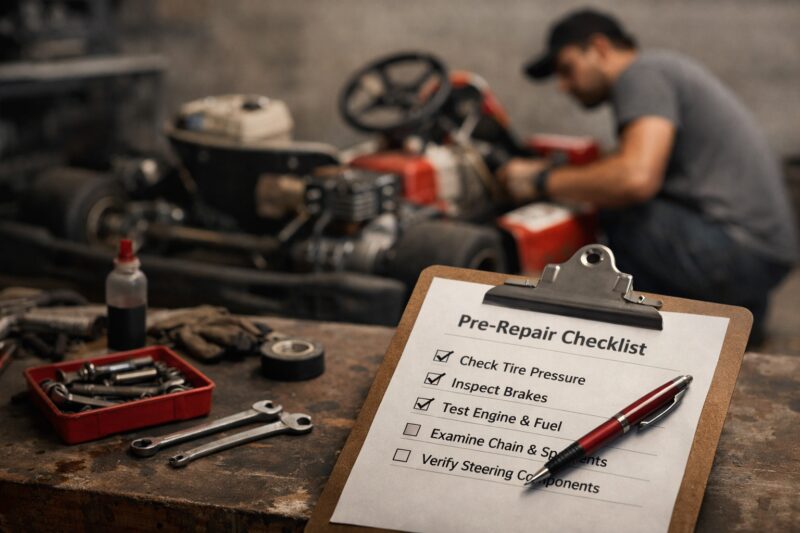
Practical criteria examples make the decision defensible. Replace only if a measured wear threshold is exceeded (like sprocket wear patterns, chain elongation indications, or bearing roughness beyond normal), adjust only if the issue is limited to a specific operating condition (like idle-only misbehavior due to mixture/idle settings), and retest after each change. Document observed data: spark test results, spark plug condition before and after changes, fuel delivery behavior, chain tension measurement or visible alignment, and clutch/bearing feel. This prevents “circular troubleshooting,” where a mechanic keeps changing variables until the kart runs but fails again quickly because the true cause wasn’t fixed.
Tradeoffs and limitations: diagnosing intermittent faults can consume time, so a Go Kart Mechanic should set scope boundaries and escalate when evidence doesn’t converge. If the kart cuts out after heat, and basic electrical checks are exhausted, specialized tools (oscilloscope-based ignition analysis, compression testing, or precise timing verification where applicable) may be required. Real-world scenario: an intermittent cutout appears every few laps. A mechanic records when it occurs, how long it runs before failure, and whether vibration correlates. Instead of replacing the carb “because it looks dirty,” they find a loose ground or connector that opens under thermal expansion.
Common Mistakes and Misconceptions in Go Kart Mechanic Work (What Most People Get Wrong)
Most repeat breakdowns happen because people skip verification and jump straight to parts swapping, which is exactly what a disciplined Go Kart Mechanic avoids. The common misconception is that the symptom directly identifies the system—yet many faults create secondary symptoms that look identical. A parts-swapping approach typically increases downtime cost because every incorrect replacement delays the root-cause fix and can damage gaskets, seals, or connectors during repeated disassembly.
One major misconception is misinterpreting symptoms: confusing fuel starvation with ignition trouble under load, or confusing clutch engagement issues with carb tuning. For example, if the kart bogs when the clutch engages, the engine may sound like it’s running lean or misfiring, but the underlying cause could be chain binding or clutch alignment. Another misconception is improper warm-up testing. Testing only cold starts can invalidate the diagnosis if the real fault is heat-related (weak ignition under thermal load, fuel vapor issues, or electrical connector expansion). The opposite is also true: relying only on hot behavior can miss carb mixture errors that only show up when the kart first starts or idles.
Deeper-than-obvious mistake: using “it runs fine on stands” as proof the engine is healthy. Stands remove the load and airflow conditions of real riding. On track, aerodynamic drag, wheel load, and drivetrain resistance change RPM and how the carb and ignition behave. Similarly, overtightening adjustments can create a new fault while trying to fix an old one—turning screws too far, damaging seals by repeated disassembly, or crushing carb gaskets. Rental operators often see this mistake because staff rotates karts quickly; they replace visible components to get back on track and then learn later that the underlying electrical or drivetrain fault remains.
Failure modes also include not checking fasteners and torque after service. Loose mounting bolts can shift alignment and lead to repeat problems that look “mysterious.” If you want a checklist-based process to reduce these failure modes, use a structured workflow and keep communication clear with authorization steps using an ask before you pay approach (for example, confirming whether additional troubleshooting labor is approved if first-line tests don’t resolve the issue).
Repair Options and Tradeoffs: DIY Checklist vs Professional Go Kart Mechanic vs Rental/Track Support
Choosing a repair path is a commercial decision: owners can handle some issues with a DIY checklist, while complex or intermittent faults are best handled by a professional Go Kart Mechanic. The tradeoffs are mostly about troubleshooting time, risk of repeat failure, and whether specialized tooling is required. If you manage a fleet or run rentals, track support workflows often matter as much as the fix itself, because turnaround time can affect revenue.
DIY with a checklist fits best when symptoms are consistent and verification is straightforward—like a clear fuel blockage, obvious loose ground wire, worn chain with identifiable misalignment, or a choke left in the wrong position. Semi-pro assistance fits when you have basic tools and some expertise but need help confirming measurements (like consistent spark quality, fuel delivery behavior, or drivetrain alignment). Full professional service fits when symptoms are intermittent, when multiple systems could be involved, or when prior attempts have already created confounding changes (for example, repeated carb disassembly). Track/rental support can be appropriate when they have standardized workflows and parts staging, though you should still request evidence-based diagnosis if the issue returns.
Practical cost drivers usually include diagnostic labor, parts availability (in-stock vs special order), and the time required to reproduce the fault under load. For intermittent issues, the “cost” is often the mechanic’s time collecting evidence—heat soak repetition, vibration correlation, and connector/wire movement tests. A useful mindset is to ask questions that clarify scope: what tests will be run before parts are replaced, what “authorization boundaries” exist for additional work, and whether the shop will provide documentation with measurements. This approach supports making good decisions quickly and reduces the risk of paying for masked symptoms.
Deeper-than-obvious nuance: when the fault is intermittent or complex, you should avoid the “buy the common part first” trap. If the fault depends on temperature, vibration, or drivetrain load, the correct fix might be electrical connectors, ground integrity, or alignment rather than a specific carb component. Real-world scenario: a rental operator repeatedly replaces spark plugs, but the misfire only happens after long runs. A pro Go Kart Mechanic eventually finds a heat-weak ignition component or failing ground path, and once repaired, repeat complaints stop.
What to Expect From a Go Kart Mechanic Service Report (For Commercial Reliability)
A reliable Go Kart Mechanic service report should provide more than a simple “fixed” remark. It should detail what was tested, what issues were discovered, and how the solution effectively addresses the root cause. For maintaining commercial reliability, comprehensive documentation not only reduces disputes and enhances consistency across staff but also expedites future diagnostics. When you are considering an off-road specialist, the quality of the report often serves as a strong indicator of the mechanic's diagnostic capabilities.
What a good report should include starts with an inspection summary. It should list the symptoms observed (cold vs warm behavior), the pre-repair condition (brake/steering/chassis notes, visible wear), and the diagnostic steps performed in a clear order. Then it should record findings such as spark test results, fuel delivery observations, carb condition notes (without implying a root-cause claim unless verified), drivetrain checks (chain tension/alignment/sprocket wear), and any electrical connector/ground inspection results. Parts used should be listed with what was replaced and why, ideally linked to a measurement or test outcome rather than a guess.
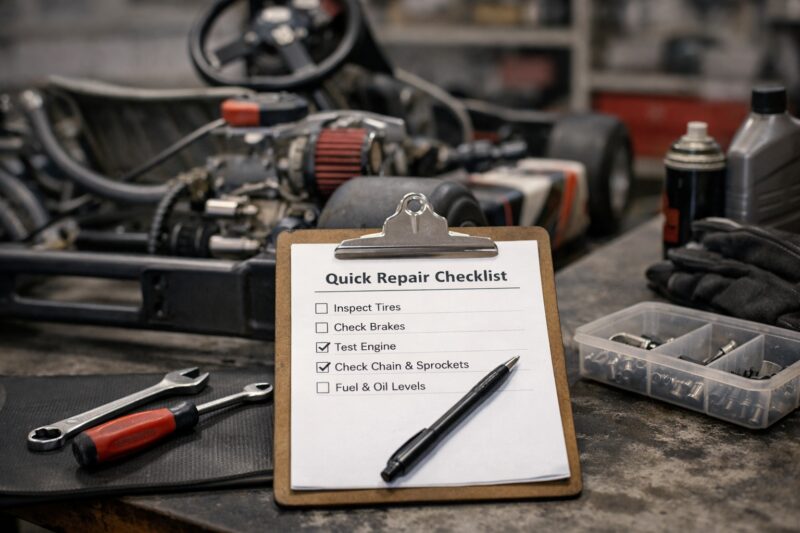
Tradeoffs and limitations: some shops do minimal documentation to reduce paperwork; however, that increases the chance of misunderstandings in commercial settings. A strong report differentiates “fix claimed” from “root-cause confirmed.” For example, cleaning a carb throat may improve idle temporarily, but if the real issue is a vacuum leak at an intake gasket, the report should explain that verification step. Real-world friction points include lead time for special-order parts and diagnostic fees. Clear communication should specify whether you’re paying for diagnosis only, diagnosis plus labor authorization, and what triggers additional approvals.
For warranties or guarantees, a Go Kart Mechanic should clarify coverage and what voids it (for example, improper operation, continued use while ignoring obvious brake drag, or repeated neglect). Customer-ready documentation often includes photos, measurements (like plug condition, chain alignment notes, or gap/tension indications), and test outcomes before and after repair. This is also the information your team needs to avoid repeating the original fault via the wrong recommissioning or “quick fix” behavior.
Regional/Market Anchor: Choosing a Go Kart Mechanic Workflow in Your Local Service Area
Choosing a Go Kart Mechanic workflow in your local service area should balance availability, seasonal demand, and parts supply timing—not just the lowest headline labor rate. Even if the diagnosis is identical, the “best fix” can differ based on local parts availability, turnaround expectations, and practical constraints like shop scheduling during the 2026 riding season. If you operate in a major racing region, your peak demand months will influence whether you pursue expedited parts or comprehensive diagnostics first.
How regional workflow decisions play out depends on your location and market norms. In the US-based market, common service workflows often focus on fast turnaround, standardized measurements, and readily available aftermarket or OEM-style parts. In many EU-based contexts, maintenance norms can be influenced by different compliance expectations and parts sourcing rules, including how certain components are specified for replacements. Local regulations affecting engine configurations and emissions-related parts can also influence replacement options on certain kart types and engines, especially where local rules apply. The key is to choose a shop that aligns its workflow with these constraints while still producing evidence-based diagnosis.
Practical evaluation criteria for nearby options should be transparent. Look for response time for diagnostics, review signals indicating diagnostic competence (not just “they replace parts fast”), and clarity about whether the shop has parts in stock or will special-order with lead times. Ask how they handle intermittent faults and whether they provide service reports with measurements. Use these questions to “choose the right shop” for your environment so you don’t end up with repeated downtime because the shop’s workflow doesn’t match your operating reality.
Tradeoffs and limitations: a faster shop might rely more on first-line parts swaps, which can be risky for intermittent issues. A slower, more meticulous shop can cost more initially but reduce repeat failures if their verification process is strong. Real-world scenario: a winter off-season storage issue shows up in spring. A shop with robust storage recommissioning procedures can prevent stale-fuel-related carb problems that other shops might misdiagnose as an ignition fault.
Frequently Asked Questions About Go Kart Mechanic
What should I check first before taking my kart apart?
Start with symptom triage: confirm whether the kart is unsafe or operationally stopped, and note when the fault happens (cold vs warm). Then do non-destructive verification such as basic fuel availability checks and confirming kill switch/ignition behavior before major disassembly. This sequencing prevents chasing secondary symptoms that waste time and money.
How do I tell if the problem is fuel or spark?
Do a quick spark test and inspect the spark plug condition for wet fouling, dryness, or heavy deposits. Then verify fuel delivery by checking line integrity, filter condition, and whether primer/bulb behavior indicates fuel is reaching the carb. Interpreting results under repeated start attempts and load helps avoid false conclusions.
Do carburetor adjustments fix most Go Karts issues?
Carb adjustments can help when symptoms match mixture/idle issues, especially for cold start or idle quality. However, adjustments can mask underlying problems like vacuum leaks, incorrect airflow, or worn float/needle behavior. A Go Kart Mechanic should confirm with verification steps after any adjustment to ensure the kart actually runs correctly under realistic conditions.
How can I prevent repeat repairs after a Go Kart Mechanic visit?
Ask for a service report that documents tests performed, measurements taken, and the root-cause logic for the fix. After repair, verify the same conditions that caused the original failure—ideally cold and warm starts, plus a short under-load test. Avoid continuing to run the kart while any symptom is still present, because it can compound wear.
What are the signs of clutch or chain wear that affect acceleration?
Look for delayed or uneven clutch engagement, burning smells, chain tight spots when rotating by hand, and visible sprocket tooth hooking or sharp wear. Check for excessive chain slack or misalignment and feel bearing roughness. A Go Kart Mechanic should decide adjust-versus-replace based on observed wear and alignment behavior.
Why does my kart run on stands but fail under load?
Stands eliminate real load, airflow, and drivetrain resistance that exist during riding. Under load, brake drag, chain binding, clutch engagement timing, and airflow changes can reveal the actual fault. Reproducing the failure conditions—safely—helps a Go Kart Mechanic avoid misdiagnosing the engine.
What long-term storage checks should a mechanic perform?
Check for stale or varnished fuel, corrosion at fuel system components, and spark plug condition affected by storage. For carbureted karts, inspect jets and confirm fuel delivery behavior before assuming ignition failure. Recommissioning should include a controlled start procedure and a short verification run to confirm stable behavior.
Can electrical issues be intermittent, and how should they be diagnosed?
Yes—heat soak, vibration, and connector movement can cause intermittent electrical faults. A proper diagnosis involves connector/ground checks, retesting during repeated heat cycles, and verifying consistent spark during realistic start attempts. Documentation of when the issue occurs helps confirm whether electrical behavior correlates with temperature or movement.
What should I ask a professional Go Kart Mechanic before approving repairs?
Ask what tests they will perform before replacing parts and how they confirm root cause, not just symptom relief. Confirm parts sourcing strategy (in-stock versus special order), labor scope boundaries, and what the warranty covers for repeat issues. Clear authorization steps help ensure you only approve work tied to verified findings.
How do two-stroke vs four-stroke diagnostics change my checklist?
Two-stroke issues often show mixture and fuel-quality effects quickly, and storage can affect oil/fuel mix behavior and plug fouling patterns. Four-stroke karts may introduce additional variables related to compression and valve train behavior that mixture tweaks won’t fix. In both cases, verifying spark, fuel delivery, and airflow before adjustments prevents misinterpretation.
If you want to turn diagnosis into a repeatable process, start by applying the triage → verify → inspect → decide workflow before any part is swapped. The commercial payoff is straightforward: better diagnosis, clearer repair authorization, and confidence that the kart’s root cause was actually addressed—not just masked. Use the checklist before repairs and request a service report that documents tests and measurements so your next service is faster. Next step: choose the right path (DIY vs pro) based on the fault type, whether it’s intermittent, and how much verification you can reliably perform at home. If you’re troubleshooting repeatedly, record baseline symptoms and measurements now so the next Go Kart Mechanic can cut straight to confirmation with less downtime.
For additional context, you can also review how a broader small-engine process fits into your overall maintenance planning—especially when you’re coordinating parts sourcing and repair timelines with a Go Kart Mechanic using a quick checklist before you call approach: https://ntroffroad.edesignerz.com/small-engine-repair/.
And if you’re comparing vendors or trying to reduce service friction, use a structured decision lens with choose the right shop guidance: https://ntroffroad.edesignerz.com/offroad-mechanic/.
When you need clear authorization framing and scope control, reference ask before you pay: https://ntroffroad.edesignerz.com/automotive-repair/.
Finally, for a broader maintenance planning pattern, align your notes with a maintenance checklist for breakdowns: https://ntroffroad.edesignerz.com/go-kart-maintenance/.
External references: US CPSC — safety and consumer guidance principles; OSHA — general hazard awareness; EPA — emissions-related regulatory context that can affect how engines/components are serviced in certain markets.
Updated May 2026