
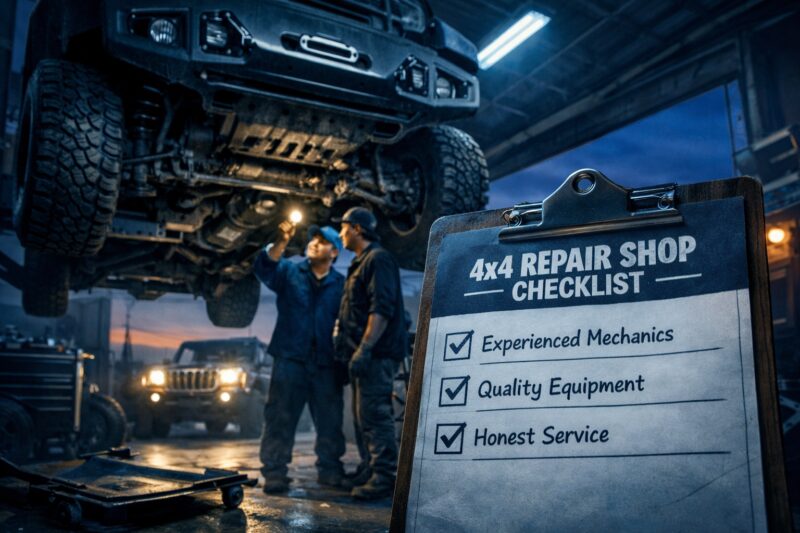
Choosing the right 4×4 Repair Shop means more than “they work on trucks.” In practical terms, a good shop delivers quality 4×4 system repairs that match your vehicle’s driveline and drivetrain design, provides transparent pricing before you approve work, documents findings clearly, and prioritizes safety during test drives and post-repair verification. If you own a lift kit, towing setup, modified transfer case or drivetrain, or you simply drive a daily 4×4 that needs intermittent faults solved, you need an evidence-based process—not guesswork. Use the checklist below to vet the shop from intake to authorization, and to decide what to approve (and what to refuse) before you sign repair orders or pay deposits. In 2026, modern shops should also show updated diagnostic workflows using current scan tool capability, data capture practices, and software/parameter verification when applicable, while still grounding everything in hands-on inspection and measurement.
How to Vet a 4×4 Repair Shop: A Decision Checklist That Prevents Costly Mistakes
A reliable 4×4 Repair Shop earns your approval by diagnosing root cause, documenting what they found, and keeping repair scope and pricing clear from intake to authorization. Your goal is to prevent the most expensive pattern in drivetrain repair: paying for parts swaps that do not address the underlying mechanical or electrical interaction.
Start with an “intake-to-authorization” workflow. When you contact the shop, the service advisor should ask about symptoms (when it occurs, what speed/load/4WD mode you’re in), warning lights, recent work (suspension, driveshaft service, transfer case/axle work), tire changes, and vehicle history. Then the shop should request permission to inspect and gather a baseline: scan tool data (including freeze-frame or stored codes), fluid condition for relevant systems, and a physical inspection of drivetrain and related components. A shop that treats your vehicle like a case study will provide a written plan for how they intend to narrow the problem, not only what they think it might be.
Commercial criteria matter because 4×4 systems are interconnected. For example, transfer case control, differential behavior, wheel speed sensing, ABS/traction logic, and drivetrain alignment all influence how the truck engages 4WD and how traction systems interpret slip. A shop that “repairs cars” broadly may handle oil changes well, but for 4×4 problems you want specialists or experienced technicians who routinely work on the specific system involved—transfer case actuation, diff locks, drivetrain/axle alignment, and 4WD engagement/actuation circuits.
Use a decision gate flow that protects your wallet: request diagnosis first, confirm findings with you, verify parts and materials sources, then authorize. A good shop will also tell you what it will not do without confirmation—such as replacing multiple expensive components “to see what happens.” What to refuse is just as important as what to approve: vague estimates (“inspect and see”), unclear labor assumptions (“diagnosis included, but not really”), or promises like “we’ll replace the transfer case if needed” without a measured justification.
Deeper than the obvious “diagnose vs. guess” line: ask how they prove root cause. Good shops describe evidence they will collect (measurements, data logs, end-play checks, torque-to-spec confirmations, actuator test results, and test-drive verification). As a deliverable example, request an estimate that includes labor line items and parts details such as brand, SKU, reman vs new, and whether they will document torque specs references and before/after measurements. If you hear vague language instead of a traceable plan, it is usually a signal to pause and ask again.

What Certifications, Tools, and Process Signals Actually Mean for 4×4 Work
Certifications and tools help, but for 4×4 work the real differentiator is process: documented inspection steps, data-backed diagnosis, verification after repair, and communication you can audit. The best 4×4 Repair Shop won’t just “have equipment”; it will use it in a repeatable workflow that reduces risk on complex drivetrain systems.
Minimum process signals should include a documented inspection sequence and scan-data usage where relevant. For example, a shop should show whether they pulled stored codes, reviewed freeze-frame conditions, and captured data during a controlled test drive. Then they should validate what changed after service—clearing codes only after verifying the underlying fault is corrected and confirming driveability and 4WD mode behavior under appropriate conditions. Calibration checks also matter: after certain repairs, sensors or actuator behaviors may require verification to ensure the vehicle responds correctly in AWD/4WD modes.
Tool readiness that matters for 4×4 goes beyond a generic scan tool. Ask whether they can diagnose AWD/4WD actuation logic, check ABS and traction system behavior (especially if wheel speed sensors are involved), and perform alignment and driveline geometry work when the symptom points to vibration, pulling, or uneven tire wear. Even if alignment is not the first suspected cause, a competent shop will explain why it may become necessary after suspension or axle service. In practice, “wrong tool” risk shows up when a shop replaces parts without verifying wheel speed sensor outputs, actuator command behavior, or the mechanical alignment that influences drivetrain loads.
Evidence-based service documentation is what you should look for every time. That means before/after measurements, references for torque specs, and a repair order that clearly distinguishes what was checked versus what was replaced. It also means the warranty terms are specific: what is covered, for how long, and whether the shop requires proof of proper vehicle operation or excludes certain failures. Common mistake: assuming that “we tightened it” is enough when a 4×4 repair needs measurement-based verification (for instance, confirming correct driveline angles or ensuring a component is installed at the correct torque and alignment settings).
A practical example of system interactions: intermittent 4WD engagement may be triggered by wheel speed sensor deviations, steering angle input errors, or traction logic interpretations. A credible shop should recognize that these “neighbor systems” can look like a transfer case problem, then investigate the chain of cause. If the shop only checks one component and swaps another without checking the supporting inputs, you often end up paying twice.
To ensure consistent decision-making, you can utilize an off-road mechanic checklist to guide discussions and minimize "memory bias" during appointments. For those aiming to expedite the repair process, employing a safety-first repair checklist can help you organize vehicle details efficiently before your appointment, streamlining the entire repair workflow.
Compare Your Options: How to Choose Between Shop Types for 4×4 Repairs
The best choice of where to take your truck depends on the type of 4×4 Repair Shop workflow you need: deep drivetrain expertise, transparent estimates, specialized diagnostics, or fast routine service with minimal risk. Choosing by problem type—not by marketing—prevents delays and helps you keep costs predictable.
You’ll typically see four categories: dedicated 4×4 specialists, general automotive repair shops, dealer service departments, and mobile diagnostic specialists. Dedicated 4×4 specialists often excel when problems relate to transfer case behavior, diff lock systems, drivetrain noise under load, or alignment needs after suspension work. General automotive shops can be fine for maintenance or straightforward components, but for complex interactions—like control logic that blends ABS/traction inputs with 4WD engagement—they may require additional coordination or subcontracting. Dealers may have strong access to OEM parts and factory documentation, which helps when you need factory-level verification or the exact calibration workflow for your model. Mobile diagnostic specialists can be efficient for getting to the truth quickly, especially for intermittent faults, but they may not handle the full teardown or specialized repair work in-house.
When each option is best can be commercial and specific. Choose a specialized 4×4 shop when you have drivetrain noise that changes with steering angle or under load, vibration that appears after axle or suspension work, or 4WD engagement problems that only happen during certain throttle positions. Choose a dealer when the repair order requires exact factory procedures, and you want OEM parts with factory-aligned documentation and warranty alignment for that vehicle configuration. Choose a general shop when the task is routine (fluids, basic sensor replacement, brake service) and the symptoms are not strongly tied to complex interactions. Choose a mobile specialist for initial diagnostic capture when warning lights are intermittent and you need data capture under the same conditions the fault occurs.
Compatibility traps are where readers usually get burned. If your vehicle has an aftermarket lift kit, non-OEM wheels/tires, or swapped transfer-case components, the shop needs to confirm that the configuration matches the diagnostic assumptions. For example, different tire sizes can affect wheel speed interpretation, and swapped components can create mismatches between control modules and expected sensor/actuator behaviors. A shop that does not ask about those details may misdiagnose the cause or recommend parts that are not correct for your build.
When comparing repair shops, it's important to inquire about how they manage the entire repair process, not just the suspected faulty part. To structure your inquiries effectively, consider incorporating key questions for verifying off-road repairs during your initial contact. Additionally, if your decision is influenced by specific build requirements, focus on selecting mechanics with proven expertise in handling your type of 4×4 repair scenario.

Pricing, Estimates, and Warranty: How to Get a Fair Deal from a 4×4 Repair Shop
A fair deal from a 4×4 Repair Shop means you can understand how the shop arrived at the estimate and what you are authorizing, not just a total price. In commercial decision-making, clarity beats urgency: a written estimate with defined diagnostic terms, labor breakdown, and parts details protects both you and the shop.
Request what should be on every estimate: diagnostic fee terms, labor hours that reflect the actual work (teardown/inspection, component replacement, reassembly, test drive verification), and a parts list that includes brand and part numbers (or at least SKU and reman vs new). Also ask whether teardown/reassembly costs are included in the diagnostic total or whether they become additional labor once the shop confirms the cause. A common failure mode is “bait-and-switch diagnostics,” where the diagnostic charge is applied, but the shop uses it to justify a larger scope without clear evidence. Another failure mode is vague line items like “inspect,” which hide what the technician actually checked.
Parts sourcing expectations should be explicit. Ask whether they use OEM equivalents, aftermarket parts that meet specific performance criteria, or remanufactured units, and what warranty each category carries. You should also confirm return policies if a component turns out not to be the correct fix. For drivetrain work, this matters because a remanufactured transfer case or differential part can be expensive, and you need to know what the shop will do if diagnostic results change midstream.
Payment and authorization guardrails are the second layer of protection. Set a deposit expectation that is reasonable and tied to actual work performed (for instance, inspection and baseline data capture). Require authorization for additional work if they discover new problems during teardown. A professional shop should have a call-before-you-go procedure so they don’t continue charging labor on work you did not approve.
Here is a compact red flags vs. green flags mini-checklist for your decision. Green flags include itemized labor hours, a parts list with identifiers, clear diagnosis assumptions, and a warranty statement that distinguishes parts coverage from labor coverage. Red flags include changing parts lists midstream without explanation, unclear diagnostic terms, refusal to provide documentation, or estimates that do not mention whether measurement-based verification will be performed after installation.
Common Pitfalls When Choosing a 4×4 Repair Shop (and What to Do Instead)
The most common pitfall when selecting a 4×4 Repair Shop is trusting that “any mechanic can do 4×4,” which often leads to guess-based repairs, repeat failures, and avoidable labor. Another frequent issue is treating diagnosis as optional because the symptom feels obvious; on 4×4 trucks, obvious symptoms can be downstream of multiple interacting systems.
Start with the misconceptions. Replacing parts fixes it is rarely true when wheel speed sensor signals, 4WD control logic, traction/ABS inputs, and drivetrain geometry are involved. Diagnosis is not optional when symptoms are intermittent (for example, 4WD engages only on the highway), when warning lights clear after restarting, or when vibration/noise depends on speed, load, and steering angle. What most guides get wrong is they focus on parts recommendations rather than how shops verify outcomes. You should require test conditions and post-repair validation that prove the fault is truly corrected.
Pitfalls specific to 4×4 include misdiagnosis of vibration or noise. A vibration that appears after a suspension job can be alignment, driveline angle, or imbalance rather than a “bad bearing.” Transfer case fluid interval assumptions can also mislead: using the wrong fluid type or incorrect service interval can accelerate wear, and worn internal components can fail in ways that mimic other issues. Alignment matters after suspension and axle work—if toe/caster or driveline alignment is off, you can cause recurring symptoms and rapid tire wear even after a successful component replacement.
When estimates change, handle it commercially. Ask what new evidence prompted the change, what parts are now expected to be replaced (and why), and whether the shop will re-authorize before further labor. Edge cases to prepare for include intermittent 4WD engagement, warning lights that clear, and customer-reported behavior “only on the highway.” In those cases, ask for a data capture approach: freeze-frame review, test drive replicating conditions, and documentation of before/after measurements. When to walk away: if a shop refuses documentation, cannot articulate how it will verify the repair, or insists on proceeding with major work without authorization.
If you want a consistent conversation structure, you can adapt the off-road mechanic checklist approach to your own scenario, and also use specific questions to ask before service to confirm the shop’s diagnostic discipline before you approve any teardown.
Advanced Considerations for Complex 4×4 Builds: Lift Kits, Towing, and Electrical Gremlins (What Most Guides Get Wrong)
Complex builds change the diagnostic strategy, so the right 4×4 Repair Shop for a stock vehicle is not always the right one for a lifted, towing-heavy, or electrically modified truck. In 2026, the shops that succeed with these builds typically combine measurement, wiring-diagram discipline, and verification across system interactions instead of relying on “plug-in and replace.”

Lift kits and driveline angle changes affect failure patterns. If you have altered suspension height, aftermarket control arms, different tire sizes, or upgraded steering components, the geometry can change how vibration and load-related faults present. Drivetrain sequencing also matters: for example, servicing axle components and then performing drivetrain and alignment checks in the right order reduces the chance that you “fix” a symptom while leaving the underlying geometry issue. A credible shop should explain what measurements they will take (and when), and how those measurements affect which components are likely candidates.
Locking differentials, transfer case behavior, and axle service sequencing can interact in non-obvious ways. If you run diff locks or have modified actuation, the shop must understand how control logic expects sensor feedback and what “normal” behavior looks like. What most guides get wrong is oversimplifying the symptom-to-part mapping. Electrical and module-related nuance is where many failures hide: credible shops handle wiring diagrams, grounding checks, corrosion inspection, connector seating, and voltage drop tests when appropriate. They should also confirm whether module parameters or calibration values need verification after certain repairs.
On the “will the shop still take it?” objection: a good shop should accept modified vehicles, but it should set expectations. They should confirm the scope of the modifications (lift kit details, tire size, aftermarket wheels, any swapped transfer-case components, added modules, and wiring changes) before guessing. Ask what documentation they will capture and how they will verify correctness after repair—both in normal operation and during the conditions that trigger the complaint. If they refuse modifications outright, you may need a specialist who has proven experience with builds like yours.
Finally, use a verification checklist after completion. Confirm test drive parameters match your original problem conditions, verify that warning lights remain off under multiple drives, and ask whether the shop re-checks torque/fasteners where applicable. If your truck tows, ask whether they can verify behavior under load (or at least explain how they will validate the systems that influence towing stability). This is where the “workflow signals” from earlier sections show up in real outcomes.
For a broader prep approach, you can start with an off-road repair shop intake that aligns expectations and keeps documentation consistent. That style of preparation often improves decision quality when you’re dealing with complex interactions like wheel-speed influenced 4WD engagement or module communication quirks.
Frequently Asked Questions About Choosing a 4×4 Repair Shop
What questions should I ask a 4×4 Repair Shop before authorizing repairs?
Ask how they will diagnose first (scan data, inspection measurements, and test-drive verification) and what specific evidence will justify parts replacement. Request an itemized estimate that separates diagnostic time, labor, and parts, and confirm whether they need your approval if the scope changes after teardown. Also ask how they document findings and what the warranty covers for both parts and labor.
How do I know if a 4×4 Repair Shop is specialized or just general auto service?
Specialized shops can explain their 4×4 workflow in terms of system interactions, such as how wheel speed signals and traction logic affect 4WD engagement. They should describe post-repair verification steps like calibration checks, road-test conditions, and before/after measurements. If their answers focus only on replacing parts without stating how they verify the correction, it’s likely general repair with limited 4×4 depth.
What should a professional estimate include for 4×4 repairs?
A professional estimate includes a defined diagnostic fee policy, a labor breakdown with realistic hours, and a parts list with identifiers (brand, part numbers, and reman vs new). It should also specify assumptions, including what they will check and what is not included. Finally, it should state whether teardown/reassembly labor is included or charged separately after diagnosis.
Is it worth paying a diagnostic fee for 4×4 drivetrain problems?
In most cases, yes—because drivetrain problems are often caused by interactions, not a single failing part. A good diagnostic fee funds root-cause investigation using scan data, inspection, and verification steps under controlled conditions. To avoid guessing, confirm what information you will receive at the end of the diagnostic work (codes reviewed, measurements taken, and proposed root cause).
Can a 4×4 Repair Shop work on lifted or modified trucks reliably?
Yes, but reliability depends on whether the shop understands how modifications affect diagnostics and verification. They should ask about lift height, tire size, aftermarket control arms, towing equipment, and any drivetrain or module changes before recommending parts. A professional shop will also document assumptions and confirm behavior after repair across relevant conditions, not just in a quick driveway test.
What are red flags that I shouldn’t use a 4×4 Repair Shop?
Red flags include vague estimates with no line items, refusal to provide documentation, and changing the parts list midstream without explaining the new evidence. Another red flag is proceeding with major repairs without authorization or pushing you with urgency that prevents you from reviewing findings. If warranty terms are unclear or only cover parts with no labor coverage, treat it as a risk signal.
How should a 4×4 Repair Shop handle warning lights that come and go?
They should capture stored codes and freeze-frame data, then replicate the conditions that trigger the fault during a test drive. Because intermittent faults can be missed easily, the shop should document what it observed before clearing codes and confirm the warning does not return during verification. Ask what data they will provide if the fault cannot be triggered immediately.
What warranty should I expect on parts and labor from a 4×4 Repair Shop?
Expect clear warranty terms that separate coverage for parts and labor. Many reputable shops will offer a defined duration for labor workmanship and a separate period for parts (OEM or reman warranties may differ). Ask whether warranty coverage depends on return policies, proper installation, and whether you must follow specific maintenance or operational requirements.
How long should 4×4 repairs take, and why do timelines vary?
Timelines vary because diagnosis can require test drives and teardown to access drivetrain components, and because parts availability can create lead time. For intermittent or electrical issues, it may take longer to capture the fault under the right conditions. A competent shop will set expectations for diagnosis timing, parts lead time, and daily communication updates.
Should I choose a dealer or independent 4×4 Repair Shop for drivetrain and transfer case work?
Choose a dealer when you want factory procedures, OEM parts matching your exact build, and access to model-specific documentation. Choose an independent 4×4 specialist when you need deep experience with aftermarket lifts, towing setups, diff lock systems, or complex 4WD logic interactions that require flexible troubleshooting. For modified rigs, prioritize the shop that can document assumptions and verify outcomes despite non-standard configurations.
Conclusion
In 2026, the “right” 4×4 Repair Shop is defined by a repeatable, evidence-based process: vet specialization, require diagnosis before parts guessing, demand transparent estimates, and confirm warranty terms you can rely on. If you follow the decision flow—diagnose → document findings → authorize scope → verify post-repair results—you reduce the chance of paying for the wrong fix and you gain clarity when symptoms are intermittent.
Commercial risk control is 4×4-specific. Drivetrain interactions (wheel speed sensing, transfer case actuation, traction/ABS logic), intermittent faults, and modified build compatibility are the areas where a general approach fails. The checklists and question prompts in this guide are designed to make those risk points explicit before you commit money or approve teardown.
Next step: shortlist 2–3 shops, bring your symptom timeline and modification details, and request written estimates before authorizing work. Use the questions to ask before service framework to ensure they explain how they will investigate root cause and how they will verify the repair under conditions that match your original problem.
If you want additional reading and workflow planning, you can review an off-road vehicle repair resource for how to prepare your appointment details and documentation, and use the off-road repair shop intake approach to standardize expectations across quotes.
For more ways to structure your selection process, the choose the right mechanic page can help you compare shops by fit, specialization, and communication reliability.
And if you prefer a checklist-first method, the off-road mechanic checklist page offers a framework you can use to track what the shop should do before you sign off.
For faster appointment outcomes, you can also reference a faster job success checklist to reduce back-and-forth and improve the odds that diagnosis starts promptly.
Internal link destination phrases included: Faster job preparation and outcomes, shop selection criteria, and structured vetting are covered through the phrases: “faster job success checklist”, “choose the right mechanic”, “off-road mechanic checklist”, and “questions to ask before service”.
Updated May 2026