
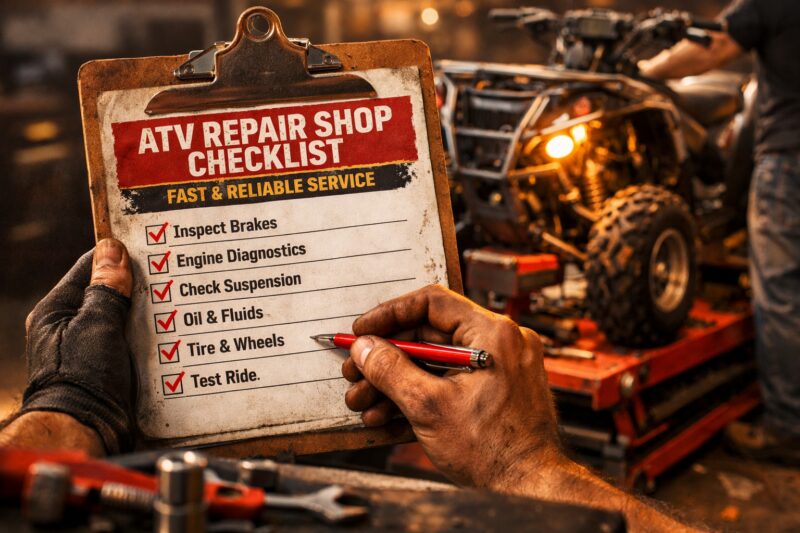
If you want faster diagnostics, transparent pricing, and reliable results, the best move is to use a repeatable intake-and-approval process with an ATV Repair Shop. This checklist helps you choose and work with a shop efficiently—without guessing, haggling mid-repair, or accepting vague timelines. It’s written for commercial intent (choosing a service provider and managing a job order), not DIY troubleshooting. In 2026, many qualified shops pair traditional measurements with digital inspections, clearer parts sourcing options, and more specific turnaround estimates, but the quality still depends on what you provide and what the shop documents. By following this script, you can help the technician reproduce the issue sooner, reduce rework, and avoid unpleasant “it wasn’t the part we replaced” surprises.
After reading, you will be able to efficiently gather necessary model and symptom details before contacting a repair shop, ensuring they can correctly triage the problem. You'll also learn to request measurable diagnostics and a written summary before approving any repairs. Furthermore, avoid delays and disputes by setting clear approval gates for parts substitutions and additional labor. By utilizing a structured checklist for ATV repairs, you can minimize downtime and prevent the first week from being consumed by unnecessary guesswork.
What should I bring to an ATV Repair Shop for faster diagnostics?
Bring a structured symptom log, your ATV’s exact configuration, and any safety-risk context so the ATV Repair Shop can triage correctly before disassembly. The faster you give the shop testable facts, the faster they can confirm the fault, measure the likely causes, and build a repair plan.
Why it matters: Many ATV failures are “data dependent”—they behave differently when cold vs hot, under load vs idle, or after a trail condition (rain, dust, mud). If you only describe the problem in general terms (“it won’t start” or “it hesitates”), the shop may need extra teardown cycles and longer test time to reproduce it. That increases labor hours, delays ordering parts, and can lead to warranty friction if the symptom returns because the root cause was never fully established.
How it works (intake triage): A strong intake process captures the triage inputs that narrow diagnostic paths immediately. At minimum, plan to provide model/year, engine type (carbureted vs EFI if you know), mileage or hours, VIN if available, and any recent maintenance (oil, coolant/antifreeze, spark plugs, belt/chain, battery). Also include recent mods such as aftermarket exhaust, ECU flashing, lift kit changes, nonstandard tires, or gearing changes—these can shift airflow, fueling, vibration patterns, or sensor expectations.
Practical application (what to gather before you call): Write down a timeline: when it happens (cold start, hot restart, only after riding), what you observe (no crank vs slow crank vs cranks but won’t fire), and how it progresses (cuts out at a specific rpm, loses power after acceleration, surges when braking). If you have error codes, transcribe them exactly as shown on the display or scan tool. If you do not have codes, describe noises/vibration (whine, rattle, grinding), starting behavior (one pull vs multiple attempts), and patterns (only in neutral, only with choke, only after rain). If available, save a short video that shows the symptom and include a temperature context (for example: “after a 20-minute ride,” “engine fully cold,” “after idling for 10 minutes”). Intermittent failures are where this checklist earns its keep.
Tradeoffs and limitations: More upfront detail can reduce labor hours, but it cannot replace diagnostic uncertainty. Your goal is not to demand certainty—it’s to share observed facts that shorten the shop’s test path. A good ATV Repair Shop will still measure, confirm, and communicate what they know versus what they hypothesize.
Real-world scenarios: If your ATV stalls only after riding through deep mud, the intake log should mention coolant temp behavior and whether you notice fuel smell or airbox moisture. If it hesitates only when cold, include how long it idles before moving and whether the choke or cold-start enrichment changes anything. If it starts fine but loses power at a specific throttle position, note whether the issue correlates with CVT belt tension, intake restriction, electrical voltage sag, or a sensor under load.
Deeper insight (edge case and common mistake): A frequent mistake is assuming “intermittent = random.” In reality, intermittent often follows predictable conditions—temperature, vibration frequency, or electrical voltage drops. What most guides get wrong is telling you to “just describe it better” without telling you to document conditions. A short video of a cold-start cutout, plus the temperature context and riding condition, can prevent misdiagnosis.
If you want a practical way to structure your first conversation, use this approach like a pre-visit script: book repairs with quick checks to confirm scope and triage inputs before you approve any tear-down.
How does an ATV Repair Shop confirm the diagnosis without rework?
An ATV Repair Shop should follow a measurable diagnostic sequence that confirms the fault, tests root-cause hypotheses, and documents deliverables before recommending repairs. When diagnostics are done well, you get fewer “replace-and-hope” cycles and more confidence in the repair plan.
Why it matters: Rework happens when a shop treats “symptom” as “cause.” For example, an engine that won’t start might involve battery capacity, starter draw, grounding, fuel delivery, spark integrity, or sensor logic. Error codes can point to a subsystem, but they do not always reveal the primary fault—sometimes a code is secondary to a voltage sag or to an intermittent connection.

How it works (diagnostic sequence): Expect a standard flow: inspection → fault confirmation → root-cause hypothesis → tests/measurements → proposed repair plan. “Good diagnostics” typically includes specific checks with measurable outcomes: compression (when relevant), fuel pressure/volume verification, spark quality checks, and electrical voltage drop tests under load. For drivetrain symptoms, expect belt/chain inspection for wear and alignment, and assessment of clutch/CVT components for rolling wear patterns. For braking/steering concerns, expect inspection of calipers, pads, fluid condition, linkage play, and alignment or preload issues as appropriate.
What deliverables should you expect: A qualified shop can provide a written diagnosis summary and recommend next steps with reasoning. You should be able to understand which tests were performed, what the results were, and why those results point toward specific repairs. In 2026, many shops can also attach photos of worn components and save test readings digitally, which improves accountability and reduces “he said/she said” disputes later.
Edge cases and conflicting evidence: Intermittent electrical issues often won’t appear on the first inspection run. Shops should handle this by testing under the same conditions you reported (cold/hot, neutral/under load, post-rain). Another edge case is “customer-reported symptoms that don’t reproduce.” A reputable shop should explain uncertainty, document what they observed during test attempts, and recommend the next logical step rather than claiming certainty. Common misconception: “If there are error codes, the fix is obvious.” Codes can be misleading when sensors detect a downstream issue or when the system logs a fault after a brief voltage or signal anomaly.
Tradeoffs: You may not get every test for free. Some diagnostic steps are mutually exclusive based on likelihood and access. A strong shop communicates tradeoffs: what they will test first, what it might rule out, and how additional tests would be approved if early results are inconclusive.
A common mistake is agreeing to a vague plan that merely states, “we’ll see what’s wrong” without clear testing expectations. It’s essential to ask how they will confirm the fault and what data will be documented. To support your decisions regarding the service scope and provider selection, consider using a checklist to clarify the right questions before you authorize payment, ensuring you fully understand the work outlined in the order. This way, you can proceed with confidence and avoid any repeat issues.
To effectively navigate the differences between specialized services and general repair options, it's essential to find the right Off-Road Repair Shop by ensuring the shop’s diagnostic methods match your specific symptoms. This alignment can significantly reduce the risk of guesswork repairs and unnecessary downtime, allowing you to make informed decisions about the services you need.
How do parts sourcing and estimates work at an ATV Repair Shop in 2026?
Reliable ATV Repair Shops quote repairs with clear labor hours, an itemized parts plan, and explicit lead-time expectations based on sourcing categories and approval gates. In 2026, many shops can offer more transparent options—OEM vs aftermarket vs rebuilt/used—while still controlling risk through fitment checks and documentation.
Why it matters: Scheduling delays often come from parts variability, not from technician availability. If the estimate does not include a parts strategy, you may experience stop-start delays: the shop pauses waiting for a backordered component, then must re-check compatibility after a substitution, which increases labor hours. That affects both total cost and turnaround time.
How it works (quote structure): A strong estimate typically includes a parts list, labor hours (by job step or diagnostic/repair tasks), any diagnostic fee, and the applicable taxes/fees. It should also explain whether the diagnostic fee is credited toward repair (if they do charge diagnostics) and how long the estimate is considered valid—especially when parts pricing can fluctuate.
Parts sourcing categories (and implications): Expect multiple sourcing paths: in-stock OEM/aftermarket parts, rebuilt components, or used/refurbished units when appropriate. Each category has tradeoffs. OEM parts usually reduce fitment uncertainty but can have longer backorders on discontinued model years. Aftermarket parts can be cost-effective and faster but require careful compatibility verification. Rebuilt or used parts can help speed up turnaround, but you should confirm inspection standards, return terms, and any limitations in warranty coverage.
Lead times, substitutions, and change control: Ask what triggers a delay (supplier backorder, shipping lane disruptions, discontinued parts) and how the shop handles substitutions. “Change control” means the shop re-approves before proceeding if additional parts or labor becomes necessary. For example, if the shop finds additional wear during teardown (worn seals, damaged mounts, compromised wiring), they should communicate options and get your approval rather than rolling costs into the final bill.
Deeper insight (hard-to-source scenario): A common mistake is treating rare-model parts as a simple “order it” task. In reality, discontinued components may require an equivalent alternative, a cross-compatible part, or an upgraded design. What most guides get wrong is not telling you to ask how acceptable alternatives are evaluated. A good shop explains criteria (dimensions, electrical spec, mounting points, compatibility with existing sensors, and expected performance impact) and documents the choice.
To streamline the process, align your intake details with the shop’s parts sourcing plan—especially if you want to avoid rework due to misfit parts.
If you also want a structured way to request scope clarity, review atv-service planning and ask how they will book repairs with quick checks for your situation.
What warranty and quality standards should I request from an ATV Repair Shop?
Ask an ATV Repair Shop to provide written warranty terms for parts and labor, plus post-repair verification checks aligned to the original symptom. Quality standards matter because the goal is durable performance, not a one-week fix.
Why it matters: Many repeat failures come from “missed root cause” repairs, incorrect parts selection, or skipping related wear items. For example, replacing a failing component without addressing the underlying cause—like oil contamination, misalignment, overheating damage, or electrical voltage instability—can cause symptoms to return and complicate warranty coverage.
What to confirm about warranty (in 2026): Request the type of warranty and the limits: parts warranty duration, labor warranty duration, and how they calculate coverage in time and hours or miles. Confirm exclusions (for example, damage from misuse or non-approved modifications) and whether used or rebuilt parts carry reduced coverage. The key is clarity: you should receive the written terms and understand what “warranty claim” requires from you if the symptom reappears.
Workmanship checkpoints you can request: Ask whether the shop uses correct torque specs, correct fluid types and grades, proper brake bleed procedure, and ensures sealing surfaces are clean and properly reassembled. For drivetrain repairs, ask about inspection checkpoints for mating surfaces and fastener condition. For any repair affecting safety, ask what test and verification they will perform before you pick up the ATV.
Verification should match the symptom: Post-repair checks should align with how the problem appeared. If the ATV failed to start when cold, expect a cold-start test. If it surged or cut out at hot restart, expect a hot restart test. If there was a power loss under load, expect a controlled ride or appropriate simulation. For braking concerns, ask for brake function verification (including pedal feel and stopping behavior), and ensure the shop can explain what they checked and why.
Common warranty failure modes: “Symptom returns” often results from a secondary cause that was not measured or from a parts selection that worked on paper but failed under real conditions. Another failure mode is inadequate communication—if the shop didn’t document uncertainty during diagnostics, warranty claims can become disputes. What most guides get wrong is advising customers to “trust the shop” without requesting written terms and a return-to-service timeline.
How to evaluate warranty that isn’t useful: Be cautious when warranty terms are verbal, vague, or lack a clear diagnostic responsibility framework. You should be able to ask: if the symptom returns, what tests will the shop run and who pays for them? A professional ATV Repair Shop can answer in concrete terms.
For a helpful list of review questions on work-order language, use what to ask before pay to compare what you’re being offered across shops.
What advanced or edge-case ATV repairs should you discuss before authorization?
Discuss advanced and edge-case repairs—overheating, charging/electrical faults, fuel contamination, CVT/transmission slipping, and braking/steering safety—before authorization so the shop can plan cascade-failure checks and manage risk. Edge cases require deeper documentation because the wrong assumption can trigger repeat failures.

Why it matters: High-risk categories often create cascade failures. A single overheating event can damage cooling components, warp surfaces, contaminate lubricant, and affect long-term starting and compression behavior. Charging faults can cause voltage instability that makes sensors behave unpredictably. Fuel contamination can lead to intermittent misfires that appear as ignition or sensor problems.
How it should be handled (cascade failures): A competent shop should treat the symptom as a starting point and check downstream effects. For example, if you report overheating and subsequent hard starting, the shop should consider whether a cooling system issue led to head-gasket concerns, degraded fuel quality, or altered ignition timing behavior. If you report repeated stalling after rain, the shop should avoid assuming water exposure is always causal and instead verify whether moisture is affecting intake, electrical connectors, or fuel delivery performance.
Modifications and compatibility: You should raise any aftermarket exhaust, ECU tuning, lifted setups, nonstandard tires, or gearing changes. These can change airflow, engine mapping, sensor calibration expectations, vibration frequency, and CVT belt loading. A common mistake is letting the shop treat modifications as irrelevant—then discovering compatibility issues after parts are installed.
Documentation depth: Ask how the shop will document workmanship: photographing worn components, saving measurements, and noting test readings. This is especially important for intermittent failures and for repairs where more than one subsystem could be involved (electrical + fuel + ignition). Save parts policy also matters: if you want to keep failed components for your own records, ask early.
Intermittent timing and environmental triggers: If you observe the issue only after rain or only after dust-heavy riding, mention those details with context. What most guides get wrong is telling you to “clean and test later” rather than documenting how conditions correlate with failure onset. An edge-case-aware shop will design tests to reproduce the trigger conditions as safely as possible.
Tradeoffs: Edge-case diagnostics can be more time-consuming because they require broader checks. The solution is not to demand unlimited testing—it’s to align on a risk-managed diagnostic plan and an approval process for additional testing if early evidence is inconsistent.
When you’re comparing shop capabilities for complex issues, a specialist-focused approach can help; you can also explore influencer marketing for SEO-style comparisons later, but start with choosing the right shop quickly based on their edge-case experience and communication cadence.
What common mistakes should I avoid when choosing an ATV Repair Shop?
Avoid choosing based only on the cheapest quote, skipping symptom details, and accepting vague turnaround promises. These mistakes lead to under-scoped diagnostics, repeated tear-downs, and disputes over cost or warranty.
Why it matters: The lowest price can be a signal of limited diagnostic scope. If the shop replaces parts without confirming the root cause, you may pay again when the symptom returns. That can cost more than a higher-priced, thorough diagnostic plan.
How the mistakes usually happen: First, people often under-report relevant changes: new tires, battery replacement, belt replacement, oil change timing, or recent rides with different conditions. Second, customers sometimes accept “we’ll figure it out” without asking what measurable tests will be used to confirm the fault. Third, shops may communicate uncertainty poorly—either overpromising certainty or failing to explain that certain intermittent faults require additional test runs.
Tradeoffs and what to do instead: It is reasonable to want speed. But speed should come from good triage and a focused diagnostic plan, not from bypassing evidence. Ask for a diagnostic approach that includes measurable checks (voltage drops, fuel delivery tests, inspection of belt/chain condition, compression checks when appropriate). For aftermarket modifications, require fitment and compatibility checks rather than assuming any part “should work.”
Misconceptions to correct: “If there are error codes, the fix is obvious” is a common misconception. Sensors can detect secondary issues, and some codes may only appear under load. “If it’s intermittent, it can’t be diagnosed” is also wrong. Intermittent electrical faults often follow temperature, vibration, or voltage thresholds that can be tested with the right process.
Edge case and conflict-resolution expectation: If the shop can’t reproduce the symptom, insist on documentation of what was tested and what conditions were used. A reputable shop explains the fee policy for diagnostics, offers next-step options, and clarifies whether a repeat inspection is needed. This prevents “free troubleshooting” expectations that can sour the relationship—and prevents unclear warranty responsibilities.
To evaluate quotes and work orders, what to ask before pay helps you compare apples-to-apples across shops.
What are the best options and alternatives to an ATV Repair Shop?
Not every service provider fits every ATV problem. The best alternative depends on whether you prioritize speed, cost, OEM parts access, specialist tooling, or a specific diagnostic capability.
Service categories and when each fits: Independent ATV-focused shops often provide specialist knowledge of CVTs, carb/EFI quirks, common off-road wear patterns, and safety system checks. General powersports or motorcycle repair shops can be suitable when the problem overlaps with common motorcycle systems (brakes, charging, ignition), but you should verify ATV-specific experience for drivetrain and off-road-specific conditions. Dealer service centers can help when you need OEM parts accuracy, recall-related work, or strict documentation, but they may have longer lead times depending on parts availability. Mobile mechanics can be a good fit for simpler issues or for initial diagnostics, but complex teardown, specialty tools, and parts warranty handling may be limited.
Tradeoffs by priority: If your ATV is down and you want rapid triage, mobile or nearby independents may help—provided they can document measurements and support reliable parts sourcing. If you need OEM parts compatibility, dealer or highly networked independent shops may reduce fitment risk. If you need specialist electronics troubleshooting or CVT/transmission diagnosis, verify that the technician can perform measurable inspections and test procedures rather than replacing parts blindly.
Decision criteria you can apply: Evaluate diagnostic approach (measurable testing, documentation), parts sourcing capability (OEM/aftermarket/rebuilt and lead-time transparency), warranty clarity (written terms for parts and labor), and communication cadence (how often status updates occur and how approvals are handled). In the work order, look for approval gates for parts substitutions and additional labor, plus explicit diagnostic fee language and limits on used parts. Also confirm how the shop handles specialty tools for your symptom type.
Deeper insight (specialist vs generalist): A generalist shop may be fine for basic maintenance, but for electronics faults, CVT/transmission slipping, or braking/steering safety issues, specialist capability becomes more important. What most guides get wrong is treating “mechanic experience” as a substitute for measurable diagnostic processes. You should ask about the specific inspection points they use—compression vs voltage drop, fuel pressure verification, belt/chain inspection criteria, and post-repair validation appropriate to the symptom.
If you’re comparing provider types quickly, choose the right shop quickly by aligning provider category with your ATV’s failure mode and your need for documented warranty terms.
How can I achieve a fast, reliable turnaround with an ATV Repair Shop?
To get a fast, reliable turnaround, follow a decision path that ties good intake data to measurable diagnostics, clear approval gates, and post-repair verification. This reduces the time spent waiting, re-testing, and arguing about what changed during the repair.
Step 1: Pre-screen with intake checklist criteria. Before you commit, use the intake checklist to confirm the shop can handle your ATV type and symptom category. For example, if your ATV has a CVT-related power loss under load, ask whether they regularly perform measurable belt/roller/clutch inspections and controlled test validation. If the symptom is primarily electrical, ask about voltage drop testing and how they handle intermittent faults.
Step 2: Align on a diagnostic plan. Request a measurable plan rather than a vague “we’ll check it.” Ask what checks they will perform first, what data they will document, and how they decide the next step if results are inconclusive. This alignment prevents rework and is the foundation for faster fixes less downtime.
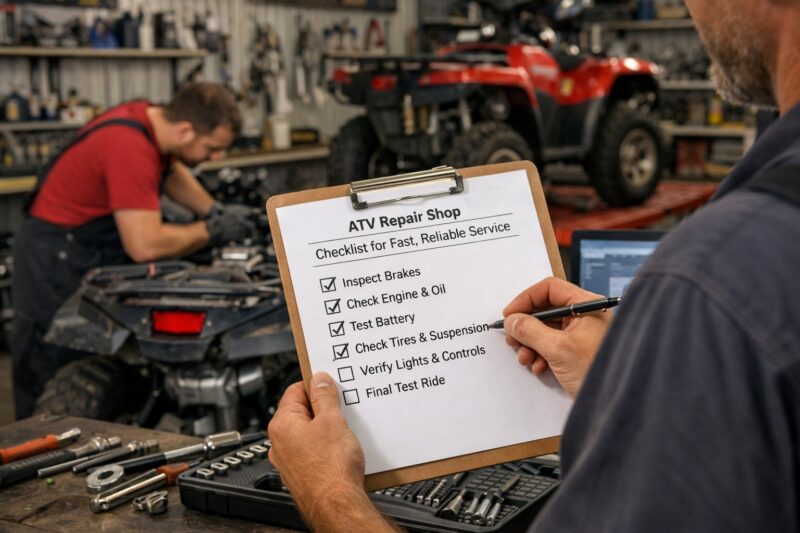
Step 3: Lock approvals (change control). Ensure you approve parts substitutions and any additional labor before work continues. Ask how they communicate backorders, what options they offer (OEM vs aftermarket vs rebuilt), and how they handle acceptable alternatives. For difficult sourcing, plan for realistic lead times and request updates on a schedule.
Step 4: Verify before pickup. Before you accept the repair, require post-repair checks aligned to the symptom and confirmation of the test conditions. Ask what was fixed, what was ruled out, and what residual uncertainty remains (if any). A professional shop provides a clear explanation and a written summary, which makes future repairs easier and supports warranty claims.
Deeper insight (escalation path if delays happen): When delays occur, ask about a predictable communication cadence and whether you can choose between alternatives. Request clarity on refund/credit policy for repeated failures and on how repeat diagnostics fees are handled. What most guides get wrong is ignoring process controls—turnaround quality is as much about communication and approval structure as it is about technician skill.
If you’re trying to compare shops efficiently, use atv-repair workflow resources like https://ntroffroad.edesignerz.com/atv-repair/ to understand how a structured process can support smoother approvals.
How do I choose an ATV Repair Shop that supports my U.S. area?
Choose an ATV Repair Shop that can reliably source parts and communicate lead times for your region’s seasonal demand and riding conditions. U.S. customers should prioritize local logistics, shipping reliability, and realistic scheduling based on when people ride most.
Why it matters: Even excellent technicians can’t control supplier backorders or seasonal throughput spikes. In many areas, summer and winter riding peaks raise demand; that can push diagnostic and repair timelines unless the shop manages inventory and parts sourcing efficiently. Region-specific conditions also affect diagnostic design—for instance, salt exposure, road grime, dust-heavy trails, or frequent mud can change how failures present.
How it works locally (what to ask): Ask the shop about their scheduling lead time and throughput limits. Confirm whether they can pick up/drop off your ATV, whether they offer mobile service for initial inspection, and what communication channels they use for status updates (text, email, phone). For parts sourcing, ask about their supplier network and typical backorder patterns for your ATV brand and model year.
Real-world scenario: If you’re in an area with harsh winter conditions, charging system and corrosion-related electrical issues may be more common. Ask the shop whether they account for region-specific exposure during inspection and whether they test connectors for corrosion and proper voltage stability under load. If you ride in dusty areas, intake restriction and filter-related problems may show up more often; request documentation of filter condition and airbox inspection.
Tradeoffs and limitations: Shops that promise immediate service may be unrealistic during peak seasons. The best approach is to ask for a realistic schedule, diagnostic timeline, and parts lead-time estimate. If an expedited parts route is possible, ask what it costs and how it affects approval gates.
Deeper insight (verification of local logistics): Confirm shipping assumptions for parts and whether the shop can handle returns if a substituted component fails fitment or spec. What most guides get wrong is not treating logistics as part of reliability. Pickup/drop-off and communication cadence directly impact whether your job finishes when promised.
If you’re selecting among nearby options, an off-road repair shop comparison can help; consider criteria like diagnostics, warranty clarity, and lead-time handling by visiting https://ntroffroad.edesignerz.com/offroad-repair-shop/ as a reference for what to expect from an off-road specialist workflow.
Frequently Asked Questions About ATV Repair Shop
What should I ask an ATV Repair Shop before I approve the diagnostic fee?
Ask what the diagnostic scope includes, what measurements or inspections they will perform first, and whether the diagnostic fee is credited toward the repair. You should also request an estimated time window for results and a description of how the findings will be documented (notes, photos, or readings). A good shop will explain what triggers additional testing so you can approve it, rather than absorbing surprises.
How do I know if an ATV Repair Shop is qualified for CVT or clutch issues?
Ask whether the technician performs measurable inspections of belt condition, alignment, and associated wear thresholds, and whether they can test under realistic conditions. You should also ask how they confirm root cause—such as whether they inspect mating surfaces and clutch components for specific wear patterns rather than guessing. Finally, request expectations for a post-repair validation test ride that matches your reported symptom conditions.
What parts warranty should I expect from an ATV Repair Shop in 2026?
Expect a warranty with a defined duration and written terms, typically separating parts warranty from labor warranty. Confirm what is covered and what is excluded, including whether used or rebuilt components have reduced coverage. If a related issue caused the part to fail, ask whether the shop will document the failure analysis and how that affects warranty claims.
How long should ATV repairs take for a typical electrical problem?
Time depends on whether the fault is intermittent, how quickly the shop can reproduce it, and how many subsystems require measurement. Intermittent electrical faults often take longer because the shop may need multiple controlled tests under cold/hot or load conditions. Ask for a communication plan—how often you’ll receive status updates while diagnostics are in progress.
Can I bring my own parts to an ATV Repair Shop?
Many shops will accept customer-supplied parts but may require compatibility verification and may limit warranty coverage for those parts. Confirm whether they will install customer parts and what happens if fitment is incorrect or the part fails—especially for electronics or drivetrain components. Ask for the shop’s acceptance criteria in writing before you purchase.
Should I replace the battery or have the ATV Repair Shop test the charging system first?
Have the shop test the charging system first if you suspect recurring starting failures, dim lights, or voltage instability. A battery-only fix can fail if the root issue is a weak stator output, regulator/rectifier problem, or poor ground that continues to drain the battery. Ask what electrical tests they perform (voltage under load, charge output checks) and why they recommend the repair sequence.
What’s the difference between OEM and aftermarket parts at an ATV Repair Shop?
OEM parts are made to the manufacturer’s specifications, which often reduces fitment uncertainty and may improve long-term consistency. Aftermarket parts can be faster to source and sometimes cheaper, but fitment and performance can vary by brand and application. In either case, the shop should get your approval for substitutions and document the rationale, especially if warranty coverage depends on the part selection.
How do I handle it when the ATV Repair Shop can’t reproduce the symptom?
Ask for documentation of what was tested, under what conditions, and what results they observed. Confirm how diagnostic fees work in non-reproduction scenarios and what next-step options are available (additional tests, condition-specific rechecks, or targeted component checks). A professional shop should communicate uncertainty clearly rather than treating non-reproduction as proof that nothing is wrong.
Do mobile mechanics count as an ATV Repair Shop for warranty and reliability?
Mobile mechanics can provide legitimate repairs, but warranty terms may be more limited depending on tooling and ability to source parts. Ask whether they provide written labor warranty, how they verify workmanship without full bench testing when needed, and what happens if the issue requires in-shop teardown. Reliability also depends on what diagnostics they can perform on-site (and how they handle documentation).
What are the most common misdiagnoses an ATV Repair Shop should avoid?
Common misdiagnoses include treating error codes as direct proof of the failing component, skipping electrical voltage drop tests, and replacing drivetrain parts without verifying alignment and related wear patterns. Another recurring failure is ignoring cascade effects like cooling damage leading to secondary engine issues. To prevent rework, the shop should document tests and explain conflicting evidence rather than overcommitting to a single assumption.
Is it safer to choose the fastest ATV Repair Shop or the most thorough one?
Fast and thorough are not mutually exclusive, but you should choose the shop that provides a measurable plan and clear approval gates. The safest option is typically a shop that can start diagnostics quickly and communicate realistic timelines based on parts sourcing. Request the diagnostic workflow upfront, then judge whether any speed claims come with missing steps or undocumented assumptions.
Conclusion: What’s the fastest way to get reliable ATV repairs in 2026?
The fastest path to reliable results with an ATV Repair Shop is straightforward: provide better intake information → insist on a measurable diagnostic plan → approve parts and labor changes through clear gates → require post-repair verification and written warranty terms. When you manage the process deliberately, you reduce the chance that the shop spends days guessing or that you get surprised by backorders and rework.
In commercial service work in 2026, customers should expect structured communication: written estimates, diagnostic scope clarity, documented test results, and explicit approval steps for substitutions and added labor. Treat turnaround like a process you can influence, not a promise you must blindly trust. Faster fixes less downtime comes from aligning facts and procedures on day one.
Call to action: Shortlist 2–3 ATV Repair Shops, then request their diagnostic workflow, parts sourcing and lead-time approach, and warranty language. Use this article’s intake checklist as your pre-visit script, and use the pickup verification checklist as your last step before you ride away. For additional guidance on choosing and managing the repair workflow, you can reference https://ntroffroad.edesignerz.com/automotive-repair/ when reviewing work-order language and approval best practices.
Next step: Choose the right shop quickly, but only after you’ve confirmed measurable diagnostics, a transparent parts plan, and a written warranty process you can rely on.
Updated May 2026