
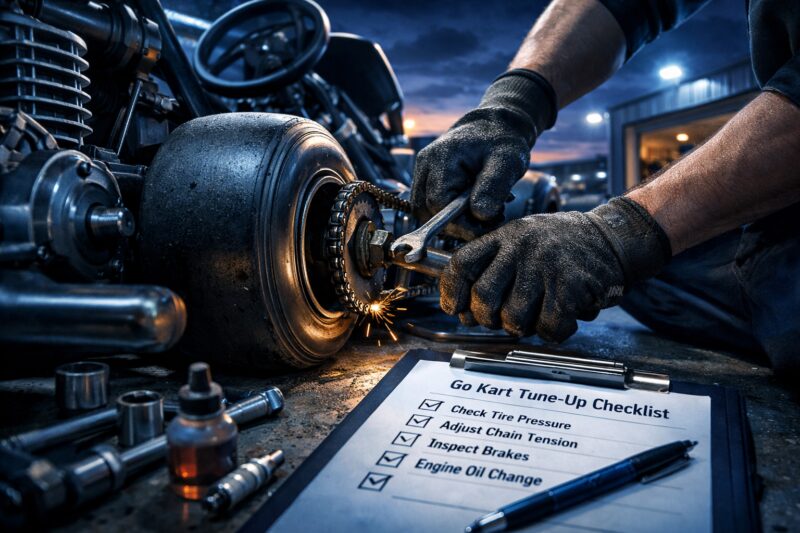
A proper Go Kart Tune Up makes your throttle smoother, boosts usable acceleration, and reduces avoidable heat and drag. This guide gives you a systematic Go Kart Tune Up checklist so you can diagnose the real cause of hesitation, surging, rough idle, or poor top-end—without guessing or making changes that damage parts. If you ride in a broad range of conditions (track days, back-woods trails, indoor carts, or backyard setups), a repeatable checklist prevents the most common “it runs worse after I tune it” scenario. I’ll focus on practical inspection and adjustment logic you can apply in 2026, while also flagging where engine type (2-stroke vs 4-stroke) and usage pattern changes what you look for.
Where you ride (location note): In 2026, many riders outside the major kit tracks still get heat soak and air-density swings from long summer sessions and cooler coastal mornings. A tune-up that feels perfect at dawn can feel flat at midday if you don’t follow baseline-to-retest logic. That’s why the checklist below starts with safety and “what has changed,” then moves to fueling/air, ignition, and finally clutch/drive and cooling.
Scope and safety promise: This article focuses on the tune-up decision-making process, covering inspection, cleaning, and basic adjustment concepts, while defining "stop and service" boundaries. It advises against delving into unrelated aftermarket topics and stresses the importance of not proceeding with a tune-up if critical components are unsafe, such as loose hardware or brake drag. If you are uncertain about how to proceed after completing the diagnostic sections, the safest option is to seek further assistance. To extend your preventive habits beyond this tune-up, consider reviewing tips for maintaining your go-kart and ensuring it remains operational and efficient.
Finally, the checklist differs in emphasis depending on engine type: 2-strokes are more sensitive to air/fuel balance and oil mix, while 4-strokes add oil/valvetrain and cooling considerations. The underlying logic stays the same: confirm symptoms, verify basics, tune one subsystem at a time, and re-test under comparable load.
When do you need a Go Kart Tune Up? (Signs to look for this week)
You likely need a Go Kart Tune Up if your kart shows repeatable drivability symptoms such as hesitation on throttle, surging, flat spots, rough idle, overheating, or a sudden drop in top-end. The key is to recognize patterns that point to fueling/air, ignition, or drive/heat rather than one-off events like a loose tool or a puddle of contamination.
Why this matters: “tune-up time” is usually wasted when riders respond to the symptom but skip the first question—what changed since the last clean run? A surging kart after a fuel switch, a flat spot after a filter swap, or overheating after a track switch are all clues that make the tune-up faster and safer. In practical terms, you want fewer misdiagnoses that lead to unnecessary part replacement or engine damage from prolonged rich running or sustained high friction.
How it works: each drivability symptom has a typical subsystem fingerprint. Hesitation or bogging when you roll on the throttle often points toward fueling/air starvation, restricted intake/venting, or throttle linkage friction. Rough idle and stalling can be idle circuit or air leak related, while poor top speed and excessive heat often reflect mixture issues, clogged airflow, clutch/drive misalignment, or drivetrain drag. When you pair symptom timing (cold vs warm, off-idle vs midrange vs full throttle) with simple observations (smell, sound, plug condition), you narrow the likely system.
Practical application: if you notice a new flat spot only under sustained load, don’t immediately chase mixture screws—first check intake restrictions, venting, and clutch/drive heat. Then, after any basic inspection fixes, re-test and document the improvement or lack of it. The goal is to keep the process grounded rather than turning the kart into a “lab” where multiple variables change at once.
Tradeoffs and limitations: not every symptom is a tune-up symptom. Severe overheating might be caused by blocked ducting, low oil (4-strokes), brake drag, or a failing cooling component. If you ignore those and tune the carb/jetting anyway, you can mask the underlying issue while still stressing the engine. Real-world scenario: many riders report “it starts fine in the driveway but dies under load.” That’s often airflow/cooling or fuel delivery under sustained demand—not just idle mixture.
What most guides get wrong: guides often imply you should “tune first, inspect later.” In reality, brake drag, a misaligned clutch, or an intake obstruction can create symptoms that look like fueling or ignition problems. In that situation, the best move is to perform the tune-up checklist’s basics first to avoid chasing the wrong subsystem.
Go Kart Tune Up goals: what “better” actually means (and how to measure it)
A good Go Kart Tune Up produces repeatable drivability improvements you can measure, not just a temporary “feels smoother” moment. The most reliable results show up in smoother throttle response, stable idle/low-speed behavior, improved acceleration without surging, and heat that stays within a safe, consistent pattern.
Why it matters: without measurable goals, you can over-tune. For example, chasing a perfect idle can push the midrange lean/rich enough to cause hesitation later, which makes the kart feel worse even though one test improved. Measurement also protects your engine: stable combustion reduces the likelihood of plug fouling, overheating, and premature wear.
How it works: use a baseline observation method before changing anything. Listen for roughness at idle, note throttle response from a stop (how quickly it pulls without a “pause”), and check how the sound changes at mid and full throttle. Smell helps too: a strong fuel smell or wet exhaust can suggest an enrichment problem or misfire. Optionally, add track notes (lap times, a short straight RPM feel, or consistent timing sessions) so you avoid judging only by “one run.”

Practical application: map symptoms to tune-up categories so you can choose what to check next. Fueling/air issues tend to cause surging, stumbles, and poor top-end with altered plug appearance; ignition problems show intermittent misfire, cold-start difficulty, or roughness during rapid throttle changes. Clutch/drive problems often show abnormal heat and delayed engagement, while engine wear/cooling problems show consistent overheating under load even after fueling changes. A helpful technique is “start easy”: confirm air intake, fuel quality/flow, and obvious mechanical bind before you touch deeper settings.
Tradeoffs and limitations: the “feels faster” trap is real. Tire pressure, alignment/true, kart setup, driver technique, and track surface grip change effective acceleration and can mimic engine gains. That’s why you should keep tire pressure and setup notes consistent between before/after tests. If your acceleration improves only on a grippy track but top-end doesn’t change, you might have a setup or clutch heat/load difference rather than improved combustion.
Deeper insight: the decision logic matters: easiest high-impact checks first, then deeper inspection only if symptoms persist. This approach reduces the chance of turning one mechanical problem into two by adjusting the wrong subsystem. For a broader preventive context, incorporate the same “measure then act” mindset used in a proper engine service checklist rather than reacting to each symptom as an isolated event.
Pre-ride safety + baseline inspection (The checklist that prevents bad adjustments)
Before any tune, do a safety-first pre-ride baseline inspection so you don’t adjust carb or ignition to compensate for a mechanical problem. A simple safety flow also prevents running the kart with binding brakes, unstable mounts, or unsafe fuel handling.
Why it matters: tune-ups can be harmful when the kart already has friction or flow restriction. If the brake is dragging, the clutch is slipping due to alignment, or the drive system is mis-seated, you can misread symptoms as “rich,” “lean,” or “bad ignition.” In that case, you may spend hours adjusting mixture while the real cause is driveline heat, not combustion quality. Preventing that diagnostic trap helps you prevent costly breakdowns.
How it works: treat pre-ride inspection like a “read-only” phase whenever possible. Stabilize the kart, confirm stands are secure, verify that wheels can rotate freely where appropriate, and inspect fuel routing and hoses without forcing anything. When running tests are needed (idle behavior, quick throttle response), keep them brief and controlled.
Practical application: visually inspect belt/chain condition (if applicable), check for cracked or glazed belt surfaces, confirm alignment components are seated, and look for loose fasteners or worn engine mounts. Examine brake drag: if the wheel won’t spin freely or you detect abnormal resistance, fix that before any mixture work. Check tire wear and whether wheels are true, since crooked wheels create vibration that can be mistaken for engine roughness.
Deeper “good looks like” guidance: frayed throttle cable housings, corroded battery/ground terminals (if electrical start is used), loose fuel line clamps, cracked intake hoses, oil leaks at gaskets (4-stroke), and damaged air filter housings are all “stop and address” items. Confirm fuel freshness using simple indicators: if fuel has sat for a long time or smells strongly stale, replace before you tune. Remove obvious intake obstructions and confirm the air path is clear.
When diagnosing your go-kart, you may need to run it briefly to investigate issues like idle or hesitation. However, avoid keeping the engine under high load if the brakes are dragging or the drive is misaligned, as these small problems can escalate into costly repairs. If you find yourself facing the need for more extensive disassembly, it might be worthwhile to consult a quick checklist for repairs, especially when dealing with safety concerns, electrical issues, or ongoing overheating problems, as these situations often call for professional expertise.
Carb, fuel, and air: dialing in clean combustion for smooth response
A stable, smooth Go Kart Tune Up starts with carb, fuel, and air verification: clean fuel delivery, unrestricted airflow, and a carb setup that matches your operating conditions. If you skip this foundation, you’ll chase phantom ignition issues or overcorrect mixture and worsen drivability.
Why it matters: combustion quality depends on consistent air/fuel balance. A restricted air filter, an intake leak, clogged fuel venting, or aged/stale fuel can create rich or lean moments that show up as flat spots and surging. These symptoms are often most obvious in mid-throttle transitions—the exact places many riders try to “tune harder,” which can backfire.
How it works: fuel must flow reliably (including venting and routing), and air must enter the carb/intake path without leaks or restrictions. For many setups, small changes in airflow can shift mixture enough to affect acceleration and top speed. In 2-stroke engines, oil/fuel mix and crankcase sealing also influence how the engine “reads” combustion conditions through plug appearance and run behavior.
Practical application: start with fuel quality and delivery. Check fuel age, confirm sediment or debris doesn’t obstruct the pickup, and verify fuel line condition (cracks, soft spots, loose clamps). Confirm vents aren’t blocked and fuel lines aren’t routed where heat can boil fuel in the line. Air delivery: inspect the air filter, ensure the housing seals properly, and check for intake leaks at carb mounting surfaces or clamps. If you find a loose clamp or cracked hose, fix that before making mixture changes.
Carb adjustment principles: without getting brand-specific, the practical concept is to ensure stable idle and clean transition to off-idle and midrange, then validate full-throttle behavior under load. Many carb problems appear “mixture-like” but are actually a throttle linkage that binds or a fuel supply issue that only shows up after a few minutes. Use short, consistent re-tests so you don’t confuse heat-soak drift with an adjustment effect.
Combustion clues (plug reading): plug color patterns can help, but interpret cautiously. Riding style, choke/starting aids, and idling time can skew readings. In humid conditions, fouling patterns can look “rich” even when fueling is correct. Edge case: a kart that stumbles only under load may be experiencing fuel starvation/venting issues rather than mixture alone. If the kart accelerates fine then bogs at sustained throttle, check fuel delivery and venting before chasing mixture.
Common mistake: adjusting mixture while airflow or fuel path problems remain. This can “sort of” fix idle while making midrange worse. The better approach is to correct air/fuel delivery integrity first, then make single-variable adjustments only after baseline is restored.
Ignition and spark health: getting reliable starts and consistent power
For a smoother, faster kart, ignition and spark health must be verified before you assume carb tuning will fix roughness. When spark is weak or inconsistent, you can see intermittent misfire, rough idle, or bogging when you throttle quickly.
Why it matters: ignition faults can mimic fueling problems because both can produce hesitation, surging, or roughness. If spark energy is insufficient, the engine may run “okay” at idle but misfire under load. That mismatch leads riders to adjust mixture and compensate for a spark problem, which can worsen overheating or plug fouling.
How it works: spark quality depends on a clean connection path, correct plug condition/gap, and—depending on engine design—coils or ignition modules operating within their normal range. Grounds matter because many ignition systems rely on stable electrical return paths. If you see corrosion, loose terminals, or damaged boots/lead insulation, spark reliability suffers.
Practical application: inspect the spark plug first. Look for heavy carbon buildup, wet contamination, and physical damage. Check wire/lead integrity and ensure the boot seats fully. Clean and verify grounding points are free of corrosion and are mechanically secure. If your engine design uses a serviceable coil or sensor, do a careful visual inspection for cracks, loose connectors, or signs of heat damage.
Timing/advance concept (without dangerous specifics): ignition timing affects when combustion initiates, which influences heat and power delivery. If timing is drastically off due to a mechanical issue, misfires, overheating, or roughness under sustained load can occur even when fueling seems “close.” That’s why you should treat ignition verification as part of a broader diagnosis rather than a last-minute plug swap.
Safe spark test decision path: use spark testing only when the procedure is safe and appropriate for your ignition design. If you cannot achieve reliable spark, stop tuning fuel/air and address ignition components first. Results that point to weak or absent spark should trigger replacement/repair of the faulty electrical components rather than further carb adjustments.
Deeper insight edge case: wet or carbon-fouled plugs can come from rich fuel or from misfires caused by ignition issues. During inspection, differentiate by looking for multiple symptoms: if plugs are wet and you also see inconsistent throttle response, both fueling and ignition may be involved, but verify spark health early to avoid a misleading plug reading. If the issue appears after cleaning the carb, ensure you didn’t introduce a vacuum leak or loosen an electrical connector—common in “I reassembled it quickly” scenarios.
Clutching, gearing, and drive: tune-up steps for faster acceleration and less heat
Clutching and drive health are core parts of a Go Kart Tune Up because a slipping or binding drive system can create heat, delayed acceleration, and even plug fouling that looks like a carb problem. If your acceleration changed but engine sound didn’t, the culprit is often clutch/drive alignment, belt/chain condition, or gearing load mismatch.
Why it matters: your engine’s combustion can be perfect, but if the drivetrain can’t transfer power efficiently, the kart won’t feel fast—and you may still overheat. Conversely, riders sometimes over-tune the carb because they misinterpret clutch slip as “engine bog.” The result is a cycle of wrong adjustments.
How it works: drive systems create a relationship between engine RPM and kart movement. When clutch engagement is delayed or belt/chain alignment is off, the engine may run in a band that generates extra heat. Slipping also increases friction work, producing a distinct smell and sound signature. Heat patterns are a diagnostic tool: if the drive area runs hotter than normal, focus on alignment, friction surfaces, and belt/chain condition before tuning fuel.

Practical application: inspect belt/chain wear, glazing, and fraying. Confirm clutch engagement surfaces are clean and not contaminated. If the kart uses a chain drive, check sprocket wear and verify alignment (a misaligned chain increases drag and heat). For systems with belts, check for proper seating and that the belt isn’t riding unevenly due to alignment. For tension and setup, follow manufacturer guidance rather than guessing, since incorrect tension can accelerate wear or cause slipping.
Setup effects that change performance: gearing ratio and tire grip change the load the engine sees. A higher-grip tire can increase load and make an otherwise “fine” mixture look rich (because RPM stays in a different band longer). Track grip also changes clutch behavior: a kart that feels fine on a grippy indoor surface may bog or overheat on a dusty outdoor track where traction drops and engagement timing changes.
Temperature + sound diagnostic approach: if you hear the engine rev up without proportional speed gain, and you detect a strong burnt smell from the drive, suspect slipping or misalignment. If you feel roughness plus vibration, check driveline true and bearings before adjusting carb/ignition. Failure mode example: a carb that’s tuned lean enough to run “okay” while slipping will become dangerously hot once you correct drive drag—so re-test after each subsystem fix.
What most guides get wrong: guides often treat clutch and gearing as “separate” from engine tuning. In reality, they strongly influence engine load and operating range. A true Go Kart Tune Up uses subsystem logic: fix clutch/drive drag first if heat and delayed acceleration are prominent, then validate fueling/air.
Engine wear and cooling: checks that keep a Go Kart running strong (not just fixed for now)
Cooling and engine health determine whether your Go Kart Tune Up results will last under real load. If your kart overheats after tune changes, or if performance fades quickly, you may be dealing with cooling airflow issues, oil problems (4-stroke), friction/drivetrain drag, or worn internal components—not just carb or ignition settings.
Why it matters: tuning can temporarily compensate for symptoms caused by heat or wear, but it cannot restore failed compression or blocked cooling airflow. Low compression can show up as weak pull, inconsistent power delivery, and increased difficulty sustaining RPM. In contrast, a blocked intake duct or poor airflow can make even a healthy engine run hot quickly under load.
How it works: cooling relies on consistent airflow through fins and correct ducting paths. When airflow is obstructed, engine temperature rises faster than the tune can manage combustion stability. Oil quality and level also impact heat on 4-stroke engines; contaminated or low oil can increase friction and temperature. For 2-strokes, crankcase sealing and proper oil delivery influence lubrication and heat under load.
Practical application: inspect cooling fins and confirm ducts aren’t obstructed by debris, bent guards, or misrouted hoses. Check oil level and oil condition for 4-strokes, and replace according to your maintenance schedule rather than “when it looks dirty.” Inspect crankcase venting lines or breathers for contamination that can alter airflow and performance. Replace or clean the air filter if it restricts airflow, but do it as part of an overall inspection so you don’t attribute overheating solely to “carb needs more fuel.”
Tune-up adjacent but essential: filter replacement, correct oil change timing (4-stroke), and verifying that intake and crankcase venting aren’t clogged are maintenance items that keep tuning stable. If you find a cooling airflow obstruction, fixing it often improves drivability without touching mixture.
When tuning stops helping: if the kart runs okay in the driveway but overheats under sustained track load, static tests can’t reproduce the real heat soak. That’s the moment to stop chasing carb adjustments and look for cooling airflow problems, friction/drivetrain drag, and load mismatch. If compression is suspected, confirm with appropriate tests (or professional evaluation) rather than continuing to tune in hopes the engine “will behave.”
For broader preventive guidance that supports reliability over repeated seasons, review a maintenance plan designed to keep systems in spec and reduce unexpected failures.
Advanced decision path: what most guides get wrong about Go Kart Tune Ups (Deep diagnostics)
The best Go Kart Tune Up approach follows a structured diagnostic workflow: symptom → likely subsystem → quick test → single adjustment → re-test. Most guides fail by encouraging random tweaks that change multiple variables at once, making the final outcome unpredictable and sometimes dangerous.
Why it matters: when you adjust fueling, air, and ignition in the same session without a controlled baseline, you lose the ability to learn. This wastes time and can damage parts through repeated overheating, rich running, or lean stress. A decision path protects the engine because it keeps you within reasonable operating changes and reduces prolonged time in unsafe conditions.
How it works: use single-variable discipline. Make one change that you can attribute to a specific subsystem—like cleaning and resealing an intake leak, verifying fuel venting, or adjusting idle circuit behavior—and then re-test under the same conditions (similar warm-up time, similar throttle test style, similar load). Document results: a short note on sound, smell, and plug appearance (before/after) speeds up future tuning.
Practical application workflow: start with the easiest “truth” checks—air leaks, fuel delivery, obvious mechanical bind, and battery/ground integrity (if applicable). Then validate spark health. Next, address fueling/air and only then adjust drive/gear/clutch conditions if heat and delayed engagement are present. If symptoms persist after the high-confidence checks, escalate to a specialist.
Edge case about plug readings: conflicting plug color can mislead you. Plug color isn’t always a pure mixture indicator because it’s influenced by oil mix (2-stroke), idling time, heat range, and how long you run before shutting off. Corroborate with behavior: if plug looks “rich” but the engine pulls cleanly under load, focus on the real problem you feel, not only appearance.
What most guides get wrong: over-tuning smoother idle. Riders often chase a perfect idle and “fix” stalling, but doing so can shift the carb operating transition and worsen mid/high response. Balance the operating band: your kart should behave predictably across off-idle transition, mid-throttle acceleration, and sustained high-load running.
Escalation criteria: stop DIY tuning and seek specialist diagnostics when you see repeated overheating after drivetrain and cooling checks, persistent electrical misfire, or abnormal compression loss. Persistent issues after disciplined single-variable attempts often require internal inspection rather than more carb turns.
Common mistakes and misconceptions when doing a Go Kart Tune Up
The most common mistakes during a Go Kart Tune Up come from skipping basics, changing too many variables at once, and mistaking drive problems for engine problems. Avoid these traps and your adjustments will be safer, faster, and more accurate.
Why it matters: a “tune” is only as good as the assumptions behind it. If you ignore air leaks, stale fuel, venting restrictions, or brake drag, you can push the engine into abnormal running conditions. That’s how misdiagnosis turns into repeated failures—sometimes in ways you can’t easily undo.
How it works: each misconception creates a loop. Example: “My kart bogs when I throttle up, so the carb is wrong.” If the throttle cable sticks, or clutch engagement is delayed, the engine will behave like it has fueling problems even when carb settings are correct. Similarly, confusing clutch slip for engine bog makes you enrich or adjust mixture when the real issue is power not being transferred efficiently.
Practical application: verify air leaks and mechanical binding first. Inspect fuel age and confirm fuel line routing is correct and unobstructed. Check brake drag before you adjust mixture, because drivetrain friction changes load and combustion demand. Avoid overusing chokes or starting aids as “fixes”; they can mask symptoms while altering combustion conditions and plug readings, leading to false conclusions.
Misinterpreting sounds and smells: fuel smell usually indicates unburned fuel or leakage, while a burning oil smell can indicate lubrication issues, overheating, or contaminated oil. Real-world scenario: riders sometimes see white smoke or heavy smoke and assume “rich carb,” but it can also be oil contamination or air filter oil saturation. Treat smell as a clue, then corroborate with behavior and inspection.
What not to do (safety): don’t run extended high-RPM tests when you suspect excessive friction, unstable fuel delivery, or weak spark. If components are unstable (loose belt, misaligned drivetrain, damaged mounts), tune adjustments won’t solve the safety hazard. If you need a structured plan for preventing recurring issues, use the same disciplined mindset from a broader go-kart maintenance routine so you fix causes, not just symptoms.
Options and alternatives: how to choose the right Go Kart Tune Up approach for your cart
You can choose a Go Kart Tune Up approach based on how confident you are with diagnostics, what tools you have, and whether the symptoms point to basic service items or deeper faults. The right approach reduces risk while keeping costs and downtime under control.
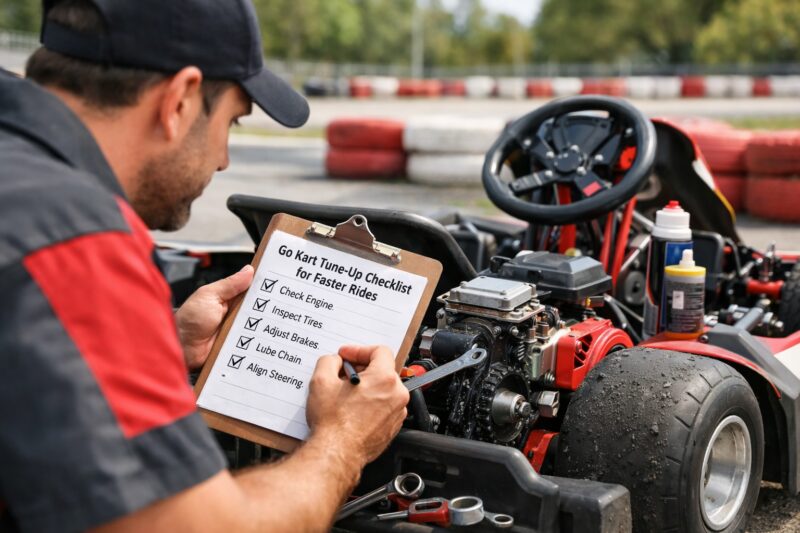
Why it matters: the “best” tune-up strategy is often a hybrid between DIY and professional service. If your kart has simple drivability problems (stale fuel, clogged filter, intake leaks, obvious plug wear), DIY inspection can resolve them quickly. If you’re dealing with ignition faults, persistent overheating, drivetrain alignment problems you can’t verify safely, or internal wear symptoms, professional diagnostics can save money and prevent engine damage.
How it works: consider four realistic approaches. A DIY checklist approach relies on observation-based tuning and basic inspection with limited adjustment. A service-first approach is where you inspect/clean/replace consumables first (filter, oil, fuel, plug) and then tune. A hybrid approach matches DIY diagnosis with professional adjustment for ignition/jetting specifics. A seasonal/track plan focuses on pre-season baseline runs plus post-session checks rather than reactive-only changes.
Tradeoffs and practical guidance: DIY is cost-effective but can be slower if you keep changing multiple variables. Service-first is faster when wear items are uncertain, but it can cost more upfront. Hybrid is ideal when you want to do the safe, repeatable checks yourself while leaving complex measurements to a specialist. Track/seasonal plans reduce “tune drift” because you record baselines and adapt to changes in air density and track grip.
What to replace vs adjust: replace wear items when inspection reveals damage (cracked hoses, frayed throttle cable, worn belts, contaminated oil), and tune only after the mechanical baseline is sound. If a cleaning restores airflow and fuel delivery integrity, you may not need adjustment. If you’re uncertain, aim for “choose the right setup” philosophy: keep changes limited and documented so you can learn what actually worked.
Environment sensitivity in 2026: local fuel blends, humidity, and temperature swings can change tuning sensitivity. You may need to re-check rather than drastically re-adjust. This reduces the risk of over-correcting due to seasonal drift.
Internal linking awareness: For riders who want help matching setups to their engine and usage, explore kart setup guidance and service categories like choose the right setup so you don’t buy tools or parts you don’t need.
Where you ride matters: location and conditions that affect your Go Kart Tune Up
Your Go Kart Tune Up results depend heavily on air density, temperature, humidity, and track load. The same carb setting that feels great in cool coastal mornings can cause hesitation or overheating when conditions shift.
Why it matters: mixture behavior changes with the amount of oxygen in the air and the heat range of your operating environment. Humidity can shift combustion characteristics, and temperature changes can affect both vaporization and the stability of fuel delivery. Altitude reduces air density, which can require different tuning outcomes for smooth acceleration and stable top-end.
How it works: when air density changes, the effective air/fuel ratio changes even if your jetting or mixture settings remain fixed. That’s why “it worked last week” can suddenly fail—small temperature and humidity changes can shift the operating band enough to cause stumbles. Track conditions also matter because sustained high load changes cooling and how long the engine runs near peak RPM.
Practical adaptation within the checklist: when conditions change, re-run your baseline observations and re-test in a consistent way. Use the same warm-up procedure, the same throttle test style, and similar run duration before you adjust anything. If your kart only misbehaves after midday heat soak, prioritize cooling airflow and clutch/drive heat checks before re-jetting. If it misbehaves primarily during initial throttle moments in cold air, verify air leaks, throttle cable smoothness, and fuel delivery stability.
Real-world scenario: on a dusty outdoor track, reduced traction can change engine load. That altered load can make a formerly correct mixture feel rich or cause slipping/clutch heat changes. Instead of immediately changing mixture, check drivetrain friction and belt/chain/bearing condition first because altered load multiplies drivetrain drag effects.
Fuel variability (conceptual): different formulations can change tuning sensitivity. Confirm with behavior and corroborating inspection: plug condition plus stable acceleration plus consistent temperature pattern is more reliable than plug appearance alone. When you suspect fuel-related changes, avoid “chasing” by doing incremental single-variable tests with documented results.
Top 10 questions about Go Kart Tune Up Checklist for Smoother, Faster Rides (FAQ)
How often should I do a Go Kart Tune Up?
Plan for seasonal service and tune checks, such as before the racing season and after any major changes in riding conditions or fuel source. You should also do earlier checks if you notice hesitation, surging, rough idle, or overheating. For high-use carts (frequent track days), do quick baseline inspections after each session and reserve deeper tuning for when symptoms persist. If you recently changed consumables like air filters, plugs, or fuel type, re-test and adjust only if behavior demands it.
What are the first things to check in a Go Kart Tune Up?
Start with the highest-impact inspections: visible air intake and hose integrity, fuel freshness and venting, throttle linkage movement, and brake drag/drivetrain bind. Then inspect spark plug condition and ensure the plug and ground/lead connections are secure. After that, check drive components for heat signs and alignment issues. This order prevents you from tuning around problems caused by restriction or friction.
Why does my kart bog when I throttle up after a Go Kart Tune Up?
Throttle bogging after tuning commonly points to fuel starvation/venting, an air leak introduced during reassembly, or a throttle cable/linkage that is binding or not opening smoothly. It can also be clutch engagement delayed by contamination or alignment issues, making power transfer feel like an engine bog. To test, verify smooth throttle movement first, then confirm fuel flow and check for intake seal leaks. If it bogs only under load, suspect drivetrain heat/drag before adjusting mixture again.
Should I tune my carb before checking my clutch and belt?
Usually, you should check clutch/drive basics before carb tuning when symptoms involve delayed acceleration, slipping heat, or unusual smells from the drive area. Carb issues can cause bogging, but clutch/drive problems can mimic engine problems by changing the load and RPM band the engine operates in. Use your decision logic: if heat and engagement behavior changed, inspect drive first; if symptoms match idle/transition with stable drive behavior, start with fuel/air. This diagnostic order prevents repeated misdiagnosis.
How can I tell if it’s a fueling problem or an ignition problem in a Go Kart Tune Up?
Fueling problems often show up as surging, flat spots, or hesitation with symptoms tied to throttle position and load, while ignition issues frequently create intermittent misfire or inconsistent spark-related behavior. A quick spark health check (plug, lead integrity, and grounding) can rule in/out ignition problems before you adjust mixture. Plug condition alone can mislead, especially if the kart idled a long time or the choke was used. Confirm with behavior patterns and short, consistent re-tests after correcting one subsystem.
What spark plug color is “right” after a Go Kart Tune Up?
There isn’t one universal “perfect” color because plug appearance depends on oil mix, idling time, engine load, and heat range. In general, you want a condition that doesn’t indicate heavy fouling (wet carbon) or extreme overheating signs (very abnormal insulator damage). Focus on whether the engine runs cleanly through transition and maintains stable performance under load. Use plug reading as corroboration, not the only decision factor.
Can stale fuel cause poor performance even if the kart starts?
Yes. Stale fuel can still start the engine but cause poor acceleration, surging, hesitation under load, and inconsistent combustion as vapors and additives degrade. Short driveway tests may not reveal the problem because load and heat soak reveal fuel delivery and combustion instability. Replace the fuel with fresh product and re-test before spending time adjusting mixture.
How do I adjust idle mixture for smoother low-speed response?
The goal is stable idle and clean off-idle transition without excessive richness or lean surging. Adjust idle mixture conceptually to achieve consistent idle speed and smooth throttle pickup at light throttle. Re-test with consistent warm-up time and brief, repeatable throttle steps so you can tell whether the change improved transition or only masked a mechanical issue. If idle adjustment makes midrange worse, stop and re-check for air leaks, throttle linkage friction, and intake seal integrity.
Is a Go Kart Tune Up different for 2-stroke vs 4-stroke engines?
Yes, mainly in how you interpret lubrication and heat-related behavior. 2-strokes depend more on correct oil/fuel mix and crankcase sealing, while 4-strokes add oil level/quality and cooling requirements. Fuel/air and ignition checks follow the same overall logic, but plug reading interpretation and the role of oil-related fouling are more prominent on 2-strokes. Always follow engine-specific service boundaries and avoid guessing on critical settings.
What should I do if my kart keeps overheating after tuning?
If overheating persists after tuning, it’s often caused by blocked cooling airflow, friction/drivetrain drag (brake drag or misalignment), incorrect operating load, or insufficient oil level/quality for 4-strokes. In many cases, tuning the carb is not the fix because overheating is driven by heat transfer and friction work. Stop extended testing, inspect cooling fins/ducts and verify oil level, then check brake drag and drive alignment. If overheating continues despite these checks, escalate to professional diagnostics rather than further tuning.
Can altitude and weather changes ruin my Go Kart Tune Up settings?
Altitude and weather shifts can change air density, humidity, and combustion stability, which can make existing tune settings feel off. You may notice hesitation, surging, or temperature instability even if nothing mechanical broke. Instead of making random turns, re-check baseline conditions and run consistent re-tests across seasons. Then adjust only one subsystem at a time, documenting results to avoid “chasing” the wrong variable.
Conclusion: your next step after this Go Kart Tune Up checklist
The core mindset behind a successful Go Kart Tune Up is simple: measure symptoms, inspect essentials, tune one subsystem at a time, and re-test under consistent conditions. When you follow that workflow, your kart becomes smoother and faster for the right reasons—better combustion, reliable spark, correct drive engagement, and stable temperature management.
Re-test discipline matters as much as the adjustments. After you make a change, write down what you changed and what improved, and capture any relevant photos such as plug condition or intake sealing points. This documentation makes your next tune-up faster and reduces the temptation to guess. It also makes it easier to decide when to stop DIY and follow a “before your next repair” escalation path if advanced diagnostics are needed.
Finally, choose your next approach based on your observed subsystem risk. If your findings point to consumables and airflow integrity, a DIY checklist with careful single-variable tuning is often enough. If ignition reliability, persistent overheating, or drive alignment failures keep appearing, move toward a hybrid or professional service approach and “choose the right setup” rather than repeatedly changing settings. Either way, you’ll get a safer, more consistent ride and fewer surprises in 2026.
Updated May 2026