
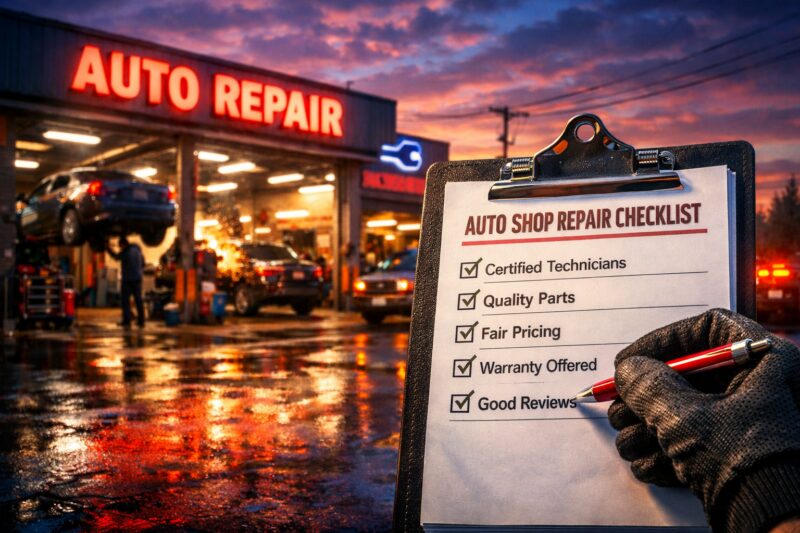
Finding the right Auto Shop fast comes down to one decision: verifying diagnostic discipline and process transparency before you approve work. Reliability matters because a misdiagnosis can waste money, a rushed repair can reduce safety, and repeat failures usually mean the root cause was never properly tested or documented.
If you need an Auto Shop in 2026, treat the search like a guided workflow: gather the minimum vehicle details, call 2–3 shops with the same checklist, and ask how they diagnose and document findings before quoting. This article is a navigational tool for what to do next, who to contact, and what to ask so you can choose a shop that can repeat correct results—not just provide a quick answer or a low estimate.
You will leave with a step-by-step checklist and a decision path that helps you choose and verify an Auto Shop before work starts. This is for drivers who need repairs quickly (or want to avoid being upsold, misdiagnosed, or stuck paying for the same failure twice).
One note on 2026 reality: you can no longer rely on price alone. You now have to verify credentials, technician capabilities for your specific system, and how the shop communicates approvals and records testing so you can confirm reliability after the fix.
Auto Shop Quick-Start Checklist (What to Do Before You Call)
Before you call an Auto Shop, collect the right details so the first conversation can lead to an accurate diagnostic plan, not a guess. The fastest route to reliable repairs is to show the shop exactly what happened, when it started, and what changed, because most “bad estimates” come from missing baseline information.
Start by clarifying the minimum info the shop needs to quote accurately. Gather your vehicle year, make, model, trim, VIN (if available), current mileage, and all relevant symptoms: noises, vibrations, drivability issues, warning lights, and any changes you noticed after weather, fuel quality, towing, or a recent repair. Note when the symptom began and whether it is constant or intermittent. If you have it, write down diagnostic trouble codes (DTCs) and freeze-frame data from your scan tool, because codes help the shop narrow likely causes and select the right tests.
Next, confirm “fast verification” details that impact your timeline. Ask for operating hours, whether they handle your repair type (for example: electrical drivability, transmission diagnostics, hybrid cooling concerns), and whether they offer diagnostics with clear terms. Also ask how estimates work: do they quote after diagnosing, do they apply diagnostic fees to the repair, and what is the approval threshold for additional tests? This prevents a common delay pattern where a shop starts disassembling, discovers something else, and then asks for approvals only after time has already been spent.
To keep reliability high, require process clarity before the shop touches the vehicle. Ask whether they diagnose before quoting, how they document findings (photos, measurements, scan-data readings, printouts), and how they communicate approvals if new information appears mid-repair. Reliability should mean consistency of results, not just friendly conversation, so you want a repair order that ties each step to a documented finding and a test confirmation.

Edge cases matter: if the issue is safety-related (brakes, steering play, overheating, “check engine” with flashing misfire), prioritize stabilization first. Ask what “imminent damage” risks they see and whether you should stop driving, inspect fluids, or use towing. A common mistake is waiting for symptoms to “go away” and then returning with a larger failure—intermittent faults often require more structured testing, so you need the shop to explain how they handle “won’t-repeat” problems.
To quickly evaluate different auto shops, it's beneficial to use a structured approach. Confirm the shop's diagnostic capabilities, documentation practices, warranty policies, and communication methods. For a deeper understanding of how these factors can help you avoid unexpected repairs, consider reviewing this guide on streamlining diagnosis and pricing. Additionally, explore various process-centered approaches and follow-up questions like those found in automotive repair evaluations.
How to Choose the Right Auto Shop: Criteria That Actually Predict Reliability
The right Auto Shop for reliable repairs is the one that proves how it thinks: it tests, documents, and stands behind results with a warranty you can understand. Instead of chasing star ratings alone, focus on criteria that predict repeatable outcomes—especially diagnostics discipline and process documentation.
Reliability criteria should be grouped so you can verify them on a call. Look first at credentials and training for your repair category: do they have ASE certifications, manufacturer training (for systems like Advanced Driver Assistance Systems), and experience with your vehicle’s engine family or transmission type? Then evaluate diagnostics discipline: do they describe how they will measure, compare scan data, and use factory service information? Confirm how they source parts (OEM, aftermarket, or remanufactured) and whether they document fitment and testing.
Pricing transparency is another predictor. A reliable Auto Shop typically provides a written estimate that aligns with documented findings, uses itemized labor lines, and explains what is included versus optional. Warranty clarity matters too: ask whether they warranty parts and labor, what time/mileage limits apply, and what claim documentation you must keep. In practice, shops that give vague quotes or avoid specific approval steps often struggle when scope changes, which is when reliability is tested.
Proof signals you can verify without being a mechanic include written estimates, itemized invoices, inspection checklists, and clear return-to-service standards. For example, for a brake-related diagnosis, the shop should describe measurements (pad thickness, rotor condition checks, fluid inspection) and confirm what they consider “safe” at the end. For engine performance issues, they should show test results that justify the final repair plan—like verifying misfire conditions under the conditions where the fault occurs.
Tradeoffs are real. Dealership-level specialization can be stronger for manufacturer-specific systems and recalls, while independent Auto Shops may excel at faster turnarounds and flexible diagnostics on general repairs. Many owners find the best outcome by matching the shop category to the problem complexity: specialty shops tend to be stronger for systems like transmissions or electrical, while dealers are often best for warranty and recall-driven repairs where documentation requirements are strict.
A common mistake when using “good reviews” as a proxy is assuming the shop’s review sample matches your exact repair scope. Reviews are influenced by bias, speed expectations, and “job type” mismatch. A shop that’s great for quick inspections may not be the best for long-tail intermittent faults requiring deep diagnostics. Another failure mode is “short-turn diagnosis” where a shop estimates based on symptom narratives rather than measurements, which often leads to repeat failures.
If you’re building a decision framework, align your calls with automotive repair questions to ask so you test the shop’s reliability signals consistently across candidates. This approach also pairs well with more auto repair tips that focus on documentation and scope control instead of generic advice.
Questions to Ask Any Auto Shop (So You Don’t Get a Bad Estimate)
To avoid a bad estimate, ask structured questions that force the Auto Shop to describe diagnostic steps, approval rules, and documentation practices before repairs begin. A reliable shop welcomes specifics because it reduces surprises for both sides.
Use a call script framework that requests: expected diagnostic steps, time estimate, total cost range, and how approvals work before repairs. For example, ask whether the diagnostic begins with scan tool checks, inspection of related components, verification tests, and whether they plan to road test. Also ask what triggers changes: what happens if initial tests don’t confirm a hypothesis? This reveals whether the shop follows a disciplined decision process or relies on component guessing.
Then cover parts and labor details so your estimate is not just a number. Ask about OEM versus aftermarket versus remanufactured parts, and specifically what they recommend for reliability in your case. Inquire whether parts are covered by a warranty and whether labor is also warranted, and request how they guarantee fit and function (for example, calibration requirements or post-replacement checks). The practical application is straightforward: you want to ensure that your repair order includes the steps that verify the repair worked, not only that parts were installed.
Request test-driven diagnosis explanations. Ask what measurements or testing they will do rather than simply replacing components. A deeper insight: when testing is limited, the shop’s plan may turn into “replace and hope.” Reliable shops explain what they will measure, what spec/threshold they are comparing against, and how they confirm the fix under real-world conditions.
Address scope creep upfront. Ask what process they follow if new findings appear mid-repair, including whether they stop work, re-check findings, and require your approval for additional diagnostics or parts. A common mistake is accepting a broad approval for “anything else you find” without a documented plan. If you feel pressure, ask for a revised estimate tied to the newly discovered evidence.
Finally, request documentation. Ask how they provide photos, scan results, printed findings, and a final repair summary that matches the estimate. For future troubleshooting and faster re-diagnosis, you want a paper trail. This is also why using an auto shop services checklist mindset helps: you can compare candidates based on what they document, not just what they claim verbally.
If you need a broader set of questions for other stages (pickup, warranty follow-up, and recordkeeping), align your checklist with automotive repair questions to ask and related more auto repair tips for how to keep receipts, photos, and work orders organized.
Common Missteps When Selecting an Auto Shop (Pitfalls & Misconceptions)
Many drivers choose the Auto Shop they think sounds cheapest or most confident, then get repeat failures because the real issue was never tested correctly. The most expensive misstep is treating a quote as a guarantee when it is actually a hypothesis awaiting diagnostic verification.
Avoid the “lowest price wins” misconception. Price can reflect efficiency, but it can also reflect limited diagnostics, fewer confirmations, or cheaper parts with weaker warranty terms. Another misconception is “they all use the same parts.” In reality, the reliability difference can be significant between OEM, reputable aftermarket, and remanufactured components, especially for sensors, modules, and seals that affect calibration and compatibility. Ask the shop what exactly they will install and what verification they perform before returning the vehicle to service.
Understand why “a quote is a guarantee” fails in the real world. A legitimate estimate often becomes conditional because intermittent faults and multi-cause symptoms require staged testing. What matters is how the shop handles uncertainty: does it document what is being tested, re-approve when findings change, and provide a path for resolving the issue if results differ from expectation? A reliable shop turns ambiguity into a structured decision process, while an unreliable shop turns ambiguity into billable surprises.
Diagnosis-first versus parts-replace-first is a major fault line. You can recognize a guessing approach if the shop cannot explain what test will confirm the component’s failure or what measurement justifies removal/replacement. For example, with overheating complaints, rushing into coolant replacement or a thermostat swap without testing airflow, pressure integrity, or fan operation can lead to recurrence if the real issue is a damaged radiator, water pump seal, clogged passages, or an electrical control problem.
Safety systems deserve extra caution. Steering, brakes, and overheating failures increase risk if repairs are rushed. A deeper-than-obvious nuance is that “fast” should not mean “untested”—a good Auto Shop can still be efficient, but it should be efficient within a diagnostic workflow, not efficient by skipping verification steps.

Operational pitfalls also matter: unclear timelines, hidden fees, vague line items (“misc. labor”), and communication patterns like “we’ll call later” without a schedule are all red flags. If the shop delays approvals or cannot explain additional charges, ask for written documentation and confirm what you are authorizing. Misunderstanding warranties is another pitfall: you need to know what is included, time limits, exclusions, and whether additional diagnostics require re-authorization.
To keep your search from drifting into guesswork, use a trusted vehicle repair shop mindset: prioritize documented process, itemized estimates, and clear scope-change approvals. When you compare shops, use the same automotive repair questions to ask so your evaluation is consistent.
Auto Shop Options & Comparisons: What Fits Your Repair and Timeline
The best way to choose an Auto Shop option is to match the shop category to the nature of your problem: complexity and documentation requirements should determine whether you use a dealer, independent garage, specialty shop, or mobile service. When you align the right category with your repair type, you typically get faster resolution with fewer repeat failures.
Start with the four common Auto Shop categories. Franchised dealers often provide strong specialization for manufacturer systems and are helpful when recalls, extended warranties, or OEM-specific diagnostics are required. Independent garages can be flexible and may offer competitive diagnostics pricing, especially for routine wear items or general mechanical issues. Specialty shops (like brake/transmission/electrical) usually invest in system-specific tools and workflows, which can shorten diagnosis for complex symptoms. Mobile or come-to-you repair services can reduce downtime for minor repairs or diagnostics, but they may be limited for deep diagnostics that require lift time, specialized equipment, or longer verification.
To evaluate each category, look for specialization depth, diagnostic tooling, estimator transparency, and typical turnaround time patterns. A decision matrix concept can help: if the issue is complex or intermittent, prioritize diagnostic discipline and documentation. If it is a routine wear item, prioritize warranty value and parts availability. For long-tail cases, the “best option” may depend on warranty constraints—some claims require OEM parts, strict documentation, or dealership-grade inspection forms.
Tradeoffs are unavoidable. Dealers may cost more but often reduce documentation friction for warranty coverage. Independent shops may be more flexible with scheduling and can be excellent for general diagnostics, yet you must verify their experience with your system. Specialty shops can be the most reliable for their domain, but they may have limited capacity or longer waiting times during peak seasons.
Here’s an optional comparison you can use as a quick self-check when narrowing to 2–3 candidates.
| Auto Shop category | Strengths | Best repair types | Typical tradeoffs |
|---|---|---|---|
| Franchised dealership | Manufacturer tooling, recall/warranty alignment | OEM-specific systems, warranty-requiring diagnostics | Higher labor rates, scheduling constraints |
| Independent garage | Flexibility, often solid general diagnostic work | General mechanical issues, routine maintenance + diagnostic follow-through | Variable depth by system unless specialized |
| Specialty shop | System-specific workflow and tooling | Brakes, transmission, electrical, drivability diagnostics | May be limited for unrelated repairs |
| Mobile/come-to-you | Convenience, reduced downtime | Simple fixes, certain diagnostics, battery/electrical triage | Limited lift access and deep testing capacity |
When you decide, confirm the shop’s policy on diagnostics and documentation so you can maintain reliability regardless of category. If you want a structured way to evaluate capabilities and expectations, the auto shop services checklist concept helps you keep comparisons apples-to-apples.
Advanced Considerations for Reliable Repairs (Beyond the Basics)
Reliable repairs depend on more than confirming the symptom; they require handling edge cases where symptoms interact, return, or conflict with prior work. When an Auto Shop is serious about reliability, it treats your case as a measurable investigation, not a one-shot guess.
Start with edge cases checklist thinking. If the issue is recurring, involves multiple symptoms, or has a history of similar failures, ask how the shop will approach root-cause verification. If your vehicle has recent modifications—aftermarket intakes, tuning, sensor replacements, suspension changes, or accessory wiring—ask whether the shop will verify compatibility and wiring integrity. Intermittent faults need a plan: ask how they reproduce the conditions, what triggers a deeper test, and how they document “no fault found” outcomes.
Tooling and workflow expectations are another advanced reliability layer. A reliable shop uses scan tool data appropriately (freeze-frame, live data, readiness monitors) and pulls factory service information when available. It should explain test procedures, not just part replacement. For calibrations (for example, certain steering angle sensors or module replacements), it should clarify whether it performs required reset/calibration steps and verifies completion through measurable checks.
Parts integrity deserves deeper attention than most guides cover. Confirm fitment verification for the specific vehicle and symptom, especially for sensors, modules, and seals where misfitment can cause leaks, incorrect readings, or immediate re-failure. Ask how the shop prevents mismatches: do they cross-check part numbers by VIN, and do they verify electrical connector condition, corrosion, and ground integrity where relevant?
Deeper nuance includes warranty/claim handling. If the repair touches a previously repaired system or a covered component, ask what paperwork they will keep and whether they will request pre-approval before repeating diagnostics or replacing parts again. Reliable documentation becomes your leverage—especially if you need to request a warranty claim—so confirm how they record what they did and what test proved the fix.
Finally, tie reliability to measurement. “Done right” should include road test verification when appropriate, re-checks of key systems, performance baselines, and confirmation that the original issue is resolved under the conditions where it appeared. A common mistake is treating a successful static test (on the lift) as proof the issue is fixed if the fault typically occurs under load or at highway speed.

To keep your records organized for future navigational searches, store copies of work orders and test results as a repair history log. If you want additional guidance on documentation and recurring problem strategies, connect your workflow with more auto repair tips and build your own evidence-based approach when contacting another Auto Shop later.
Locating the Right Auto Shop (National Search Strategy + Local Anchors)
To locate the right Auto Shop quickly, start with a short list strategy: find several candidates fast, narrow to 2–3 based on diagnostic and warranty transparency, and confirm they can meet your timing needs. This approach reduces the risk of calling a great-rated shop that cannot handle your urgency or repair type.
Use a navigational workflow that begins where searchers already look: maps listings, local directory results, and the shop’s official website service scope. Don’t treat the first listing as your answer; treat it as a starting point. Your narrowing step should be based on whether the shop clearly offers diagnostics for your category of problem, publishes warranty/estimate terms, and communicates how approvals work. Many shops bury these policies, so prioritize websites that openly describe diagnostic fees, estimate conditions, and warranty coverage.
Before calling, do evaluation steps readers can do in minutes. Scan for service scope pages that mention your likely system (engine performance, electrical, transmission, brakes) and look for signs of process transparency like “diagnostics included,” “inspection checklist,” or “written estimate.” If their site only markets discounts and does not explain diagnostic policies, plan to ask those questions during the call so you can compare consistently.
Local anchors matter even when you search nationally. You should choose within practical distance/time, and confirm towing or after-hours options if needed. If your issue can cause further damage (overheating, brake/steering safety symptoms), confirm how they handle urgent vehicles and whether they can schedule a diagnosis quickly or require a tow. Availability traps happen when a shop has excellent reviews but only takes certain job types, focuses on quick maintenance, or does not have the capacity for long diagnostic hours.
Geographic-level trust signals can help if you’re using a chain with multiple locations. Look for consistency in policies across locations and confirm the exact shop branch that will handle your repair. Ask whether the same diagnostic process and warranty policies apply at your location, and whether they use similar documentation standards. A common mistake is assuming one location’s performance equals another location’s reliability.
To make this navigational step reproducible, align your screening with an auto shop services checklist approach and your question set with automotive repair questions to ask. For deeper support on choosing a shop that aligns with your risk tolerance and paperwork needs, review a trusted vehicle repair shop process and reuse the same questions across candidates.
Top 10 questions about Auto Shop Finder Checklist for Fast, Reliable Repairs
Use these top questions to run your Auto Shop Finder checklist like a decision test: each question probes diagnostics discipline, transparency, or reliability signals before you approve work. The goal is not to win an argument—it’s to confirm the shop can reproduce results for your specific problem.
1) “What steps will you take to diagnose my issue before quoting?” This verifies diagnostic discipline and avoids parts-replace-first guessing.
2) “Will you provide a written estimate and explain what is included?” Written, itemized estimates predict fewer billing surprises and better reliability follow-through.
3) “Do you apply diagnostic fees to the repair if I approve the work?” This helps you avoid paying twice and supports process alignment.
4) “What will you do if you find additional problems mid-repair?” Reliability requires re-authorization and scope-change documentation, not surprise add-ons.
5) “What parts will you use (OEM, aftermarket, remanufactured) and what warranty covers parts and labor?” Reliability depends on fitment and coverage terms, not just cost.
6) “How do you document findings (photos, scan data, measurements)?” Documentation makes it possible to confirm the fix worked and to handle warranty claims.
7) “What testing will confirm the repair is complete (road test, performance checks, re-checks)?” A common mistake is assuming a completed repair equals a verified repair.
8) “How long will the diagnostic take and what is the realistic turnaround once approved?” Timing transparency reduces stress and prevents rushed work when the issue is complex.
9) “Have you handled this exact system or similar cases on my vehicle type?” Evaluating experience with your specific system prevents mismatch between general repair ability and your problem.
10) “What should I expect in communication, and when will I hear back next?” Reliable shops schedule updates and manage approvals predictably.
Tradeoff to remember: a shop that answers every question clearly and documents everything may not be the cheapest, but it usually reduces the risk of repeat failures. If you want a broader set of supporting questions across stages—diagnostics, pickup, and warranty follow-ups—connect your checklist to automotive repair questions to ask.
How do I find a trustworthy Auto Shop near me?
Start with a shortlist of 2–3 Auto Shop candidates based on published diagnostic services and clearly stated warranty or estimate policies. Before authorizing diagnostics, verify they can handle your repair category, confirm diagnostic pricing rules, and ask how they document findings. Then approve diagnostics only when their process includes measurable testing and a plan for re-authorization if scope changes.
What should I ask before paying for diagnostics at an Auto Shop?
Ask what diagnostic steps they expect to perform, an estimated time range, and whether the diagnostic fee is credited toward the repair if you approve it. Clarify the approval threshold for additional tests or tear-down, and request what documentation you will receive (for example scan printouts or measurements). This ensures you pay for a structured investigation rather than a vague “check it and see” process.
Can an Auto Shop give an estimate before diagnosis?
Some shops can give a preliminary estimate for likely causes, but it should be conditional and clearly labeled as such. Ask whether the estimate depends on diagnostic confirmation and what evidence would change the plan. If they avoid diagnostics entirely, that is a common reliability red flag, especially for intermittent issues.
What does a “warranty” from an Auto Shop usually cover?
Warranties usually separate parts coverage and labor coverage, and they often include time and mileage limits. Ask what the shop warrants specifically, how to file a claim, and what documentation you must keep (work order, invoice, photos). Also confirm common exclusions, such as damage from driving conditions or failures caused by unrelated systems.
Are OEM or aftermarket parts better for reliable repairs?
OEM parts often offer the best compatibility and are helpful when calibration or manufacturer documentation is critical, but reputable aftermarket parts can be reliable if fitment and testing are verified. The key detail is not the label—it is whether the Auto Shop confirms correct part number, compatibility, and whether the warranty covers both parts and labor. Ask how they prevent mismatches for sensors, modules, and seals.
What if the Auto Shop finds additional problems after the estimate?
A reliable Auto Shop should stop, document what changed, and re-authorization you before additional repairs or diagnostics begin. Confirm they provide a revised estimate tied to the new findings and explain why the added issue affects performance or safety. Request the updated documentation so it matches the final repair summary.
How can I tell if an Auto Shop is overcharging?
Look for transparency: itemized labor, clear parts pricing, and line items that correspond to documented findings. Red flags include vague charges like “inspection” without evidence, inconsistent explanations between phone and work order, or fees that appear without prior approval. Benchmark the reasonableness of labor steps by asking what testing or time is included for each line item.
What should I do if the repair doesn’t fix the problem?
Return promptly and ask for warranty evaluation under the shop’s repair-back process, including re-diagnosis expectations. Request that the shop compare your symptom today to the original documented findings and provide a written update of what they tested now. Keep all paperwork so escalation stays organized within the warranty terms.
How do I choose between a dealer and an independent Auto Shop?
Choose the dealer when you need manufacturer-specific diagnostic tools, recall-related documentation, or coverage alignment with warranty constraints. Choose an independent Auto Shop when you want flexibility, faster scheduling, and strong diagnostics for general mechanical issues. In both cases, verify experience with your specific system and confirm warranty terms and documentation practices before approving work.
Is it normal for an Auto Shop to require vehicle inspection before service?
In many cases, yes—an inspection is operationally necessary to confirm symptoms, safety risks, and diagnostic direction, especially when faults are intermittent. However, the shop should still explain what they need to see upfront, what it will cost, and how they will communicate next steps. Avoid shops that delay your approval process without providing documentation or diagnostic scope.
Long-tail: What’s the fastest way to get reliable repairs from an Auto Shop?
Use a readiness checklist to gather vehicle details and symptom timing, then shortlist 2–3 Auto Shop candidates. Call using the same questions for diagnostics steps, documentation, and re-authorization rules, and approve diagnostics only when the plan is measurable and documented. Confirm the next scheduled update time, and keep receipts and photos so a future visit is faster if the issue returns.
Long-tail: How do I confirm an Auto Shop can handle my specific vehicle issue?
Ask about experience with your vehicle system and similar cases, including what tools and testing procedures they use for that category. Request the specific measurements or tests they will perform and what would cause them to change the plan. If they cannot explain how they will confirm root cause for your symptom conditions, choose a shop that can.
If you want a checklist-driven way to compare candidates, keep your questions aligned with the same structure each time and reuse the approach behind trusted vehicle repair shop selection. For broader supporting materials and call scripts, browse more auto repair tips and review the auto shop services checklist page for step-by-step evaluation prompts.
Conclusion
To get fast, reliable repairs in 2026, you need a navigational path: build a shortlist of Auto Shop candidates, verify diagnostic/process transparency, and only approve work when the shop can document findings and re-authorization rules. When you choose using evidence-based criteria—warranty terms, itemized estimates, and test/verification steps—you reduce the risk of repeat failures and scope confusion.
Use the pitfalls section as your guardrails: don’t anchor on lowest price, don’t accept vague quotes without measurable testing, and address scope changes through clear approvals. The reliability predictors are the shop’s ability to explain how it will confirm the fix, not just how it will install parts.
Your next step is practical: call 2–3 Auto Shops using the same questions, compare answers side-by-side, and pick the option that provides the clearest documentation and process. Then keep a repair record (work orders, invoices, photos, and scan outputs) so your next navigational search is faster and more accurate.
Updated May 2026